Shane Larson
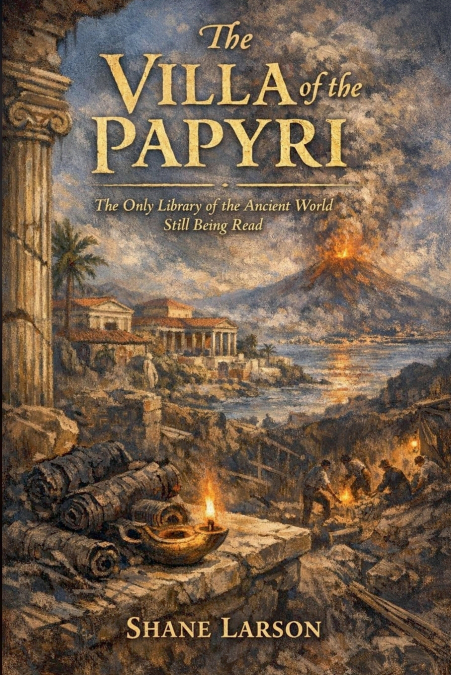
Every library of the ancient world is gone. One survives - and for two centuries, nobody could open a single book in it.In August of 79, Vesuvius destroyed Herculaneum with surges of superheated gas and ash. It did not burn the library in the town’s grandest villa. It carbonised it. The heat drove the water out of roughly eight hundred papyrus scrolls at a temperature just short of combustion, leaving them chemically stable, structurally intact, and completely unreadable - a shelf of black cylinders that crumble at a touch.What followed is one of the strangest stories in archaeology. Workmen tunnelling for statues in the 1750s threw an unknown number of scrolls away as charcoal before anyone noticed the writing. Then came two hundred years of well-intentioned destruction: scrolls sliced lengthwise, scrolls treated with mercury vapour, scrolls fed into a Vatican priest’s unrolling machine that took four years per roll and shredded most of what it touched. Six scrolls sent to the Prince Regent of Britain never came home. By the twentieth century, the honest scholarly verdict was that the surviving rolls would never be read.That verdict was wrong. X-ray tomography can now image the inside of an unopened scroll, and machine learning can detect the faint surface texture of carbon ink on carbonised papyrus - a signal no human eye can see. In the last few years, whole passages have been recovered from scrolls nobody has physically opened. The library turns out to belong to an Epicurean philosopher writing for a Roman patron who may have been Julius Caesar’s father-in-law. And two floors of the villa have never been excavated.This is the whole arc told as one story: the seaside villa and its sculpture-filled gardens, the philosopher Philodemus and the patron who kept him, the twenty-four hours that ended Herculaneum, the tunnels dug by candlelight, the machines and the mercury, and the quiet revolution in imaging that turned an elegy into a recovery still under way. It is a detective story two hundred and seventy years long, with a final act happening now.What you’ll learn:Why carbonisation preserved the scrolls - and why 'burned' is exactly the wrong wordWho owned the villa, and what a private Roman library reveals that no catalogue canHow Herculaneum died differently from Pompeii, and why that difference saved the booksThe full history of the attempts to open the scrolls, from silk threads to chlorine gasHow virtual unwrapping actually works, explained plainly and without jargonWhat has genuinely been recovered so far - and the honest odds on lost Sophocles, Ennius, and LivyThe case for and against excavating the villa’s two untouched lower floorsThis book is for you if:You know Pompeii’s story and want the stranger one from the same dayYou are drawn to lost libraries and want one that is being recovered rather than mournedYou like technical detective work explained clearly, with no equations and no hand-wavingYou want ancient history that states odds instead of selling fantasiesThe scrolls were unreadable for nineteen hundred years. They have been readable for about three. Read the story while it is still being written.