Shane Larson
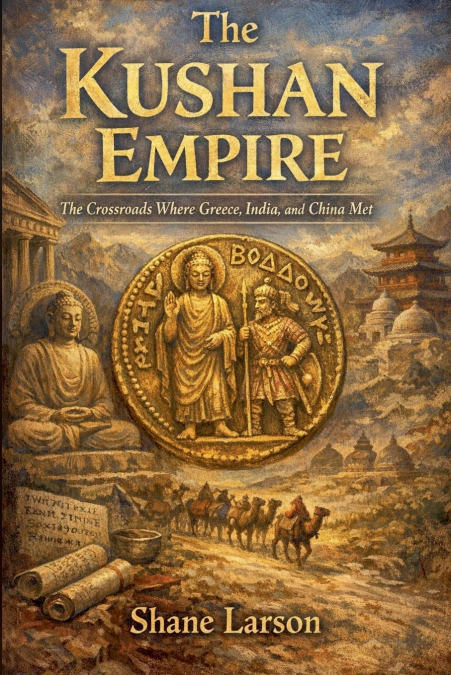
For roughly four hundred years, Buddhist art refused to show the Buddha. Then an empire founded by displaced nomads put him on a gold coin.The coin is smaller than a thumbnail. On one side, a king in a heavy nomad coat stands at a fire altar, circled by Greek letters spelling out an Iranian language. On the other, a haloed figure in a monastic robe raises his hand beside a word no Greek ever needed: BODDO. The Buddha. On money. The king who struck it descended from the Yuezhi, a nomad confederacy driven off the Chinese frontier by the Xiongnu three centuries earlier - and by his reign, beginning around AD 127, their empire ran from the Oxus to the Ganges plain and taxed every road worth taxing between Rome’s east and China’s west.Almost nobody has heard of them. The Kushan Empire left no narrative history in any language - no chronicle, no successor with a reason to remember it. For over a century, scholars could not agree on when its greatest king was crowned, and its second king had no known name at all until 1993, when workmen in northern Afghanistan turned up a stone carrying the royal genealogy in the dynasty’s own voice.This book reconstructs the empire the only way it can be reconstructed: from the objects. The coins that carry the king-list no scribe wrote down. The Greek city on the Oxus with a theater and a gymnasium. The sealed storerooms at Begram packed with Roman glass, Chinese lacquer, and Indian ivory. And the sculpture of Gandhara and Mathura, where - under Kushan patronage - the Buddha acquired a human face whose descendants stand in every Buddhist country on earth.What you’ll learn:How the Xiongnu drove the Yuezhi west - and how the refugees ended up ruling an empireWhy Bactria was still Greek two centuries after Alexander, and what the conquerors chose to keepHow historians build a king-list from coins when no king-list survivesWhat the Rabatak inscription revealed in 1993, and why a single stone rewrote the dynastyHow Gandhara and Mathura gave the Buddha a face - and why the question of which came first remains honestly unresolvedHow Kushan taxation turned the Silk Road into a through route, with Roman gold flowing in and silk flowing outHow Buddhism crossed a continent to China along Kushan-taxed roadsThis book is for you if:You love Silk Road history and suspect the middle of the route has a story of its ownYou’ve stood in front of Gandharan sculpture in a museum and wondered who paid for itYou enjoy history that shows its working - how a conclusion was reached, not just what it isYou want ancient history beyond Greece and Rome, told without jargonYou’d rather hear exactly what we don’t know than a tidy story the evidence can’t supportBy the last page, you’ll be able to stand in front of a Kushan coin or a Gandharan relief and read it unaided. Start with the gold coin that says BODDO.