Ashcroft J. Penrose
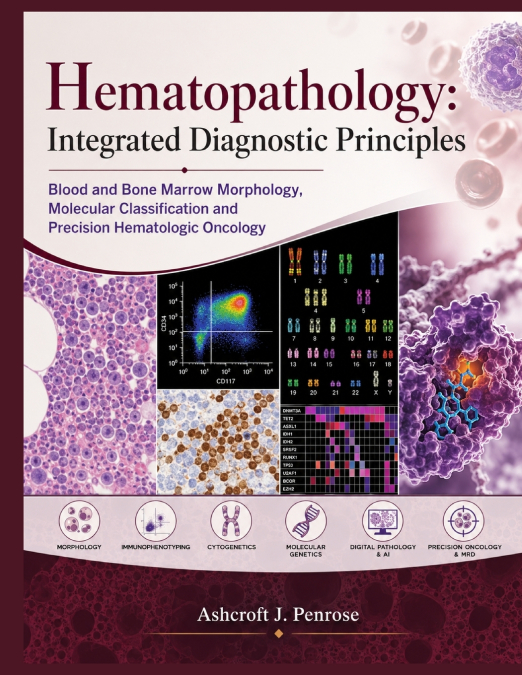
A modern understanding of blood and bone marrow disorders requires far more than recognition of abnormal cells. Contemporary hematopathology depends on the integration of morphology, immunophenotyping, flow cytometry, cytogenetics, molecular genetics, tissue architecture, and clinical information to establish precise and biologically meaningful diagnoses.This comprehensive reference presents hematopathology as an integrated diagnostic discipline, moving from the examination of peripheral blood and bone marrow specimens to molecularly defined hematologic neoplasms and precision-oriented disease assessment. It emphasizes the reasoning process behind diagnosis and demonstrates how apparently discordant findings can be reconciled within a coherent clinicopathologic framework.The book explores the full spectrum of modern hematopathology, including myeloid neoplasms, acute leukemias, lymphoblastic disorders, mature B-cell and T/NK-cell neoplasms, Hodgkin lymphoma, plasma cell disorders, histiocytic and dendritic cell neoplasms, and hematolymphoid disease arising in specialized clinical settings. Particular attention is given to genetically defined entities and the growing influence of molecular classification on contemporary disease nomenclature.Diagnostic technologies are treated as interconnected components of a unified workflow. Detailed discussions address flow cytometry, immunohistochemistry, conventional cytogenetics, FISH, next-generation sequencing, measurable residual disease assessment, and the interpretation of molecular findings in morphologically complex cases. The text also distinguishes diagnostic, prognostic, and predictive biomarkers and examines their implications for classification, risk assessment, treatment selection, and longitudinal disease monitoring.A major emphasis is placed on integrated reporting and diagnostic problem-solving. Readers are guided through situations in which morphology, flow cytometry, cytogenetics, and molecular testing do not initially agree, with attention to specimen adequacy, sampling effects, clonal heterogeneity, clonal hematopoiesis, disease evolution, and technical limitations.The book also looks toward the rapidly developing future of the field, examining digital pathology, computational image analysis, artificial intelligence, single-cell technologies, spatial biology, liquid biopsy, circulating tumor DNA, germline predisposition, and emerging approaches to precision hematologic oncology.Designed for hematopathologists, pathology residents and fellows, hematologists, hematologist-oncologists, laboratory medicine specialists, and advanced medical trainees, this work provides a rigorous framework for understanding how cellular morphology, tissue architecture, immunophenotype, genomic alterations, and clinical behavior converge to define hematologic disease.Its central principle is straightforward: the most accurate hematopathologic diagnosis emerges not from a single test, but from the disciplined integration of complementary evidence.