Ramon C. Henson MD
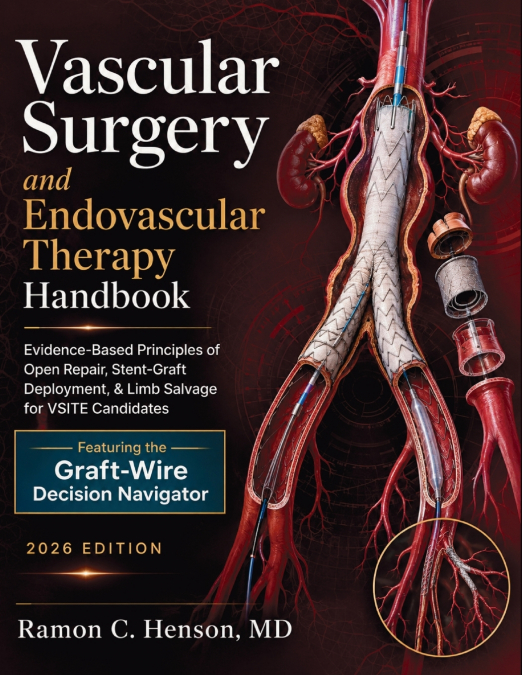
Know Which Route to Take - Open, Endovascular, or Hybrid - Before You’re in the Room. Built for the vascular surgery resident, fellow, and practicing surgeon who has to choose between open reconstruction, endovascular therapy, and hybrid technique under real time pressure, this handbook grounds every management decision in the vascular anatomy, hemodynamics, noninvasive diagnostics, and imaging findings that determine which pathway actually fits the patient in front of you. It moves across the full territory of contemporary practice - the aorta from root to bifurcation, cerebrovascular and upper extremity disease, peripheral arterial disease from claudication to limb-threatening ischemia, mesenteric and renal circulation, venous and lymphatic disease, trauma, dialysis access, and the perioperative surveillance that determines whether a reconstruction stays patent. Every chapter carries the Graft-Wire Decision Navigator, a five-part callout - Fork, Open Route, Endo Route, Hybrid Corridor, Navigator Anchor - that names the single factor tipping a case toward one pathway, consolidated at the close of the book into a fully indexed Decision Navigator Atlas. From the Vascular Lab to the Hybrid Suite, You Will Learn How To WIfI-stage the threatened limb - conduit availability and wound/ischemia/foot-infection scoring that decides bypass versus tibial angioplasty. Triage acute limb ischemia by Rutherford category - the staging that separates thrombolysis, surgical embolectomy, and primary amputation at presentation. Read the proximal aortic neck - length, angulation, and diameter criteria that route AAA repair toward EVAR, open repair, or fenestrated reconstruction. Call Stanford type A without hesitation - dissection, intramural hematoma, and penetrating ulcer management staged by ascending involvement and malperfusion. Sequence chronic venous disease treatment - CEAP-driven decisions from compression through endovenous ablation to ulcer-healing protocols. Build and salvage dialysis access - the fistula-first hierarchy, maturation criteria, and thrombosis/steal-syndrome revision pathways. Sequence trauma under the lethal triad - hard-and-soft-sign triage, temporary shunting, and damage-control staging across every anatomic region. Classify endoleak and hold the surveillance line - duplex velocity and sac-diameter trends that catch a failing graft before it fails. Every fork in this book is a fork your next patient will face - put the Graft-Wire Decision Navigator to work before that patient is on the table.