Inicio > Humanidades > Filosofía > Filosofía: epistemología y teoría del conocimiento > The Managed Mind, Power, Language, and the Architecture of modern Science
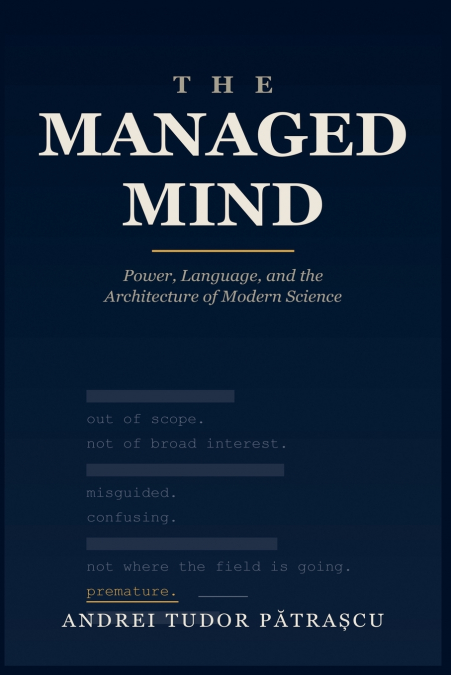
The Managed Mind, Power, Language, and the Architecture of modern Science

The Managed Mind, Power, Language, and the Architecture of modern Science

Andrei Tudor Patrascu

53,97 €
IVA incluido
Disponible
Editorial:
Andrei Tudor Patrascu
Año de edición:
2026
Materia
Filosofía: epistemología y teoría del conocimiento
ISBN:
9798237131307
53,97 €
IVA incluido
Disponible
Añadir a favoritos

The easiest way to stop an idea is not to prove it wrong. It is to make it unaskable.Modern science tells a heroic story about itself: errors are corrected, evidence accumulates, and truth wins because truth is stronger than politics. The Managed Mind asks what that story leaves out - the quiet infrastructure where questions are converted into deliverables, novelty into risk, and curiosity into caution.Following Alex, a researcher who begins to read institutional language the way an intelligence analyst reads intercepts, this book uncovers a vocabulary that ends inquiry without ever making a claim you can argue with. Out of scope. Not of broad interest. Premature. Misguided. Confusing. The words sound reasonable. They carry no malice. And yet they decide futures - routing which ideas get time, funding, legitimacy, and the right to become real.From a two-in-the-morning library to seminar rooms in Paris, Berlin, New York, and beyond, Alex discovers that the same closures repeat across countries, disciplines, and bureaucracies whose missions never overlap. The repetition is too clean to be an accident. It is not that everyone shares an opinion. It is that they share a tool.But this is not a book of grievances, and it is not cynical. Its promise is practical: once the language is decoded, it loses much of its force. Readers will finish able to hear a polite dismissal and recognize its function, to separate an objection about truth from an objection about alignment, to tell when 'ethics' is being used as a synonym for liability management - and to answer with calm questions that force vagueness to become operational, or to reveal itself as governance.Part narrative nonfiction, part field manual for epistemic self-defense, The Managed Mind is a book for scientists, students, and anyone who has ever been told, without argument, that their best question was simply not where the field is going.For readers of Thomas Kuhn, James C. Scott, and Jerry Muller - a spy-thriller sensibility applied to the sociology of knowledge.


Artículos relacionados

  • Vier Quellen Der Erkenntnis
    Ellis Potter
    Woher wissen wir etwas? Weil es ‚wissenschaftlich bewiesen‘ ist oder ‚in der Bibel steht‘ oder es ‚sich in mir einfach richtig und wahr anfühlt ‘? Wissen wir alles auf gleiche Weise? Passen unterschiedliche Wege der Erkenntnis zusammen in ein Leben und eine Wirklichkeit?In dieser kompakten Ausgabe, dem zweiten Teil einer Trilogie, zeigt der internationale Referent Ellis Potter ...
    Disponible

    12,44 €

  • Fichte’s 1804 Wissenschaftslehre
    Illuminating new essays on Fichte’s 1804 Wissenschaftslehre, or The Science of Knowing.Fichte’s 1804 Wissenschaftslehre, or The Science of Knowing, consists of a series of lectures he delivered in his Berlin home to members of the city’s political and cultural elite in 1804. The lectures mark a dramatic shift in the terminology and methodology he uses to explore the nature of k...
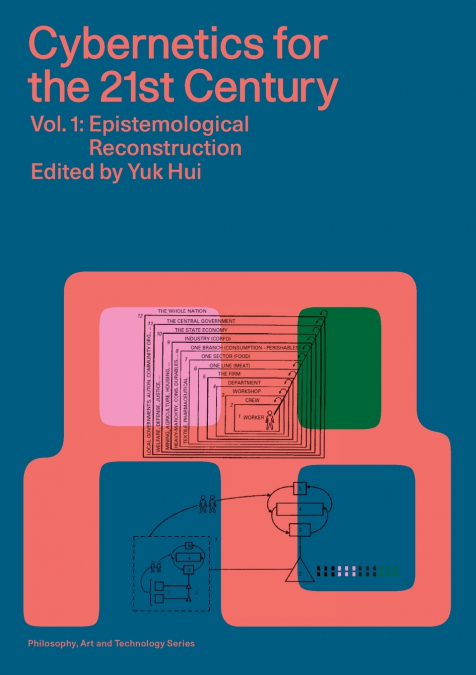
  • Cybernetics for the 21st Century Vol. 1
    Andrew Pickering / Katherine Hayles
    Cybernetics for the 21st Century Vol.1 is dedicated to the epistemological reconstruction of cybernetics, consisting of a series of historical and critical reflections on the subject - which according to Martin Heidegger marked the completion of Western metaphysics. In this anthology, historians, philosophers, sociologists and media studies scholars explore the history of cyber...
    Disponible

    20,84 €

  • Huellas de San Agustín en Kant
    Javier Narváez Arango
    El libro se desarrolla en tres partes. En la primera encontramos el tiempo, el espacio, el fenómeno, el númeno, las categorías, los juicios sintéticos a priori, el mundo, el alma y Dios, expuestos por Kant en la Crítica de la razón pura. En la segunda parte encontramos los mismos temas desde san Agustín, haciendo un paralelo, para mostrar las semejanzas entre estos autores, enc...
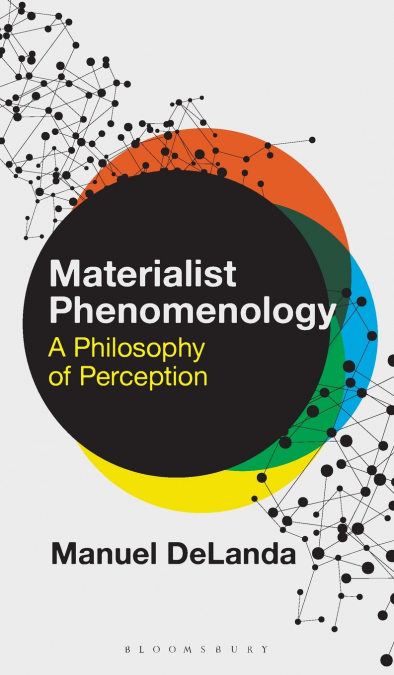
  • Materialist Phenomenology
    Manuel DeLanda
    Bringing together phenomenology and materialism, two perspectives seemingly at odds with each other, leading international theorist, Manuel DeLanda, has created an entirely new theory of visual perception. Engaging the scientific (biology, ecological psychology, neuroscience and robotics), the philosophical (idea of ’the embodied mind’) and the mathematical (dynamic systems the...
  • A Certain Ambiguity
    Gaurav Suri / Hartosh Singh Bal
    While taking a class on infinity at Stanford in the late 1980s, Ravi Kapoor discovers that he is confronting the same mathematical and philosophical dilemmas that his mathematician grandfather had faced many decades earlier--and that had landed him in jail. Charged under an obscure blasphemy law in a small New Jersey town in 1919, Vijay Sahni is challenged by a skeptical judge ...
    Disponible

    23,19 €