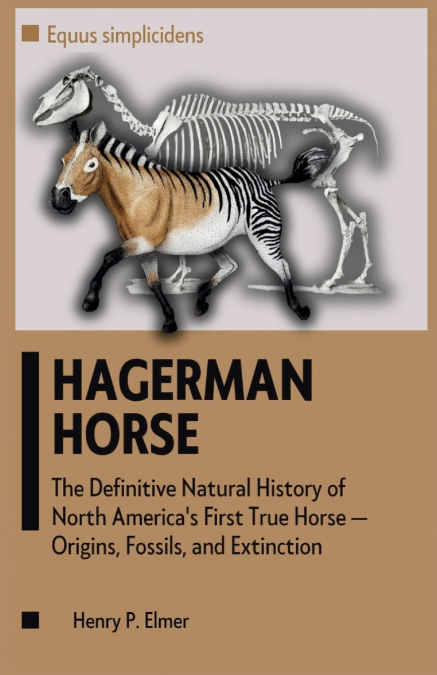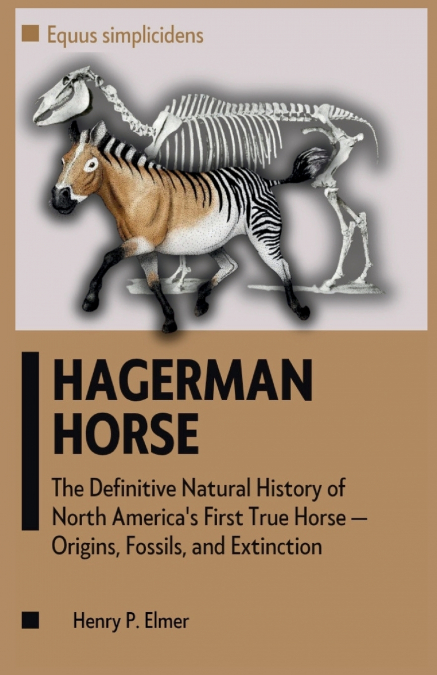
HAGERMAN HORSE (Equus simplicidens)

HAGERMAN HORSE (Equus simplicidens)

Henry P. Elmer

25,21 €
IVA incluido
Disponible
Editorial:
Indy Pub
Año de edición:
2024
Materia
Rocas, minerales y fósiles
ISBN:
9798349501029
25,21 €
IVA incluido
Disponible
Añadir a favoritos

In 1928, a rancher near Hagerman, Idaho, stumbled onto a fossil deposit that would eventually yield more than two hundred skeletons of a single extinct species, the largest concentration of fossil horses ever found in one place. That animal, Equus simplicidens, is now recognized as one of the earliest true representatives of the genus Equus, and its remains have become central to the scientific understanding of how the modern horse family evolved.Hagerman Horse traces the full natural history of this Pliocene-era species, from its evolutionary origins among earlier horse lineages to its physical characteristics, likely coloring, and life in the grassland and floodplain ecosystems of ancient Idaho roughly three and a half million years ago. Henry P. Elmer draws on decades of paleontological research conducted at the Hagerman Fossil Beds National Monument, now a protected U.S. National Park Service site, to explain how this discovery changed scientific thinking about horse evolution and the deep fossil record of the American West.The book examines the anatomical evidence that links Equus simplicidens to both earlier ancestors and later horse species, the climate and habitat conditions of the Pliocene epoch that shaped its evolution, and the environmental changes that eventually contributed to its extinction. It also explores the broader significance of the Hagerman fossil beds as a scientific resource, and what the site continues to teach paleontologists about mammalian evolution in North America.Written in a clear, narrative style accessible to general readers as well as students of paleontology, geology, and evolutionary biology, Hagerman Horse offers a complete, well-researched account of a species that stood at a critical branching point in horse evolution, long before horses as we know them existed anywhere in the world.
Artículos relacionados

  • Essentials of Igneous and Metamorphic Petrology
    B. Ronald Frost / Carol D. Frost
    ...
    Disponible

    91,68 €

  • Elija su pez. Guía para el comprador de peces de agua marina
    TRISTAN LOUGHER
    Comprar un pez para un acuario marino tropical puede ser un quebradero de cabeza. Este libro proporciona información básica sobre una gran variedad de peces. Incluye indicaciones sobre el tamaño, la alimentación, el lugar de procedencia, las diferencias morfológicas entre macho y hembra, el tipo de acuario que necesita cada especie, la convivencia con otros peces, la compatibil...
    Disponible

    54,03 €

  • Heavy Metal
    Philippe Tortell
    Heavy Metal: Earth’s Minerals and the Future of Sustainable Societies brings together world-leading experts from across the globe to reimagine the future of mineral exploration and mining in a post-fossil fuel world.Minerals and metals - for batteries, circuit boards, wiring and other components - are essential to a digital, carbon-neutral economy. But how can we grapple with t...
    Disponible

    69,16 €

  • Heavy Metal
    Philippe Tortell
    Heavy Metal: Earth’s Minerals and the Future of Sustainable Societies brings together world-leading experts from across the globe to reimagine the future of mineral exploration and mining in a post-fossil fuel world.Minerals and metals - for batteries, circuit boards, wiring and other components - are essential to a digital, carbon-neutral economy. But how can we grapple with t...
  • Metamorphic Rocks
    ...
    Disponible

    93,91 €

  • Moldavite
    Blue Dragoon Books
    Moldavite is a forest green, olive green, or blue greenish vitreous silica projectile glass formed by a meteorite impact in southern Germany that occurred about 15 million years ago. It is a type of tektite and a gemstone. Moldavite is found in the Czech Republic, southern Germany, Austria, and Moravia.Moldavite is a powerful stone that is known for its transformative propertie...
    Disponible

    17,85 €

Otros libros del autor

  • MEGALODON (Otodus megalodon)
    Henry P. Elmer
    No predator in the fossil record captures the imagination quite like Otodus megalodon. Estimated to have reached lengths of up to sixty feet, with a bite force strong enough to crush the skeleton of a whale, megalodon dominated the world’s oceans for more than fifteen million years, from the early Miocene until its extinction roughly three and a half million years ago. And yet ...
    Disponible

    34,16 €

  • DODO Raphus cucullatus
    Henry P. Elmer
    Few creatures have shaped the human imagination as thoroughly as the dodo, and few are as poorly understood. Raphus cucullatus lived only on the island of Mauritius, evolving over millions of years without natural predators until it lost the need, and eventually the ability, to fly. Then, within less than a century of first contact with European sailors in the 1600s, it was gon...
    Disponible

    31,63 €

  • HAGERMAN HORSE (Equus simplicidens)
    Henry P. Elmer
    In 1928, a rancher near Hagerman, Idaho, stumbled onto a fossil deposit that would eventually yield more than two hundred skeletons of a single extinct species, the largest concentration of fossil horses ever found in one place. That animal, Equus simplicidens, is now recognized as one of the earliest true representatives of the genus Equus, and its remains have become central ...
    Disponible

    38,27 €

  • MEGALODON (Otodus megalodon)
    Henry P. Elmer
    No predator in the fossil record captures the imagination quite like Otodus megalodon. Estimated to have reached lengths of up to sixty feet, with a bite force strong enough to crush the skeleton of a whale, megalodon dominated the world’s oceans for more than fifteen million years, from the early Miocene until its extinction roughly three and a half million years ago. And yet ...
    Disponible

    47,22 €

  • DODO (Raphus cucullatus)
    Henry P. Elmer
    Few creatures have shaped the human imagination as thoroughly as the dodo, and few are as poorly understood. Raphus cucullatus lived only on the island of Mauritius, evolving over millions of years without natural predators until it lost the need, and eventually the ability, to fly. Then, within less than a century of first contact with European sailors in the 1600s, it was gon...
    Disponible

    30,33 €