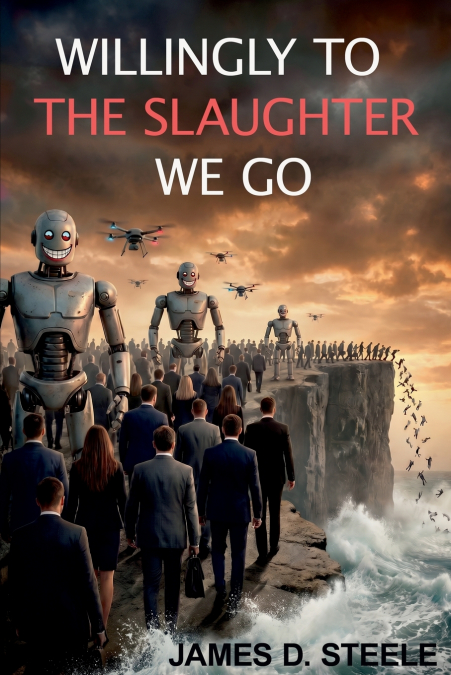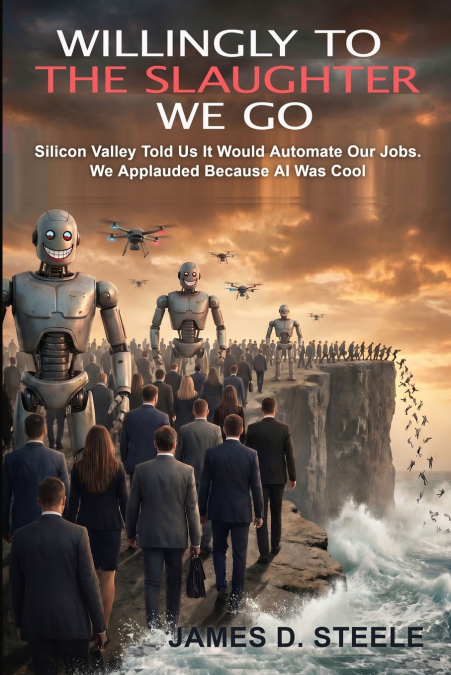
James D Steele
Second edition, revised and expanded. Reporting current through September 1, 2026.On a January morning too cold to hold the inauguration outdoors, the row behind the President’s family was reserved for technology. Musk closest to the President. Bezos beside him. Pichai, Zuckerberg, Brin, Cook. Their companies were worth roughly fifteen trillion dollars. Two rows ahead of the cabinet nominees.Nothing about what followed was hidden.The most powerful people in technology have described, in public, the world they intend to build - one in which nearly everything a person does for a living is done by artificial intelligence and robotics. The desk jobs go first. The AI learns the work. A company that can hold its output while shedding salaries will shed the salaries, and once one company does it, its competitors follow or lose. This was not a forecast. It was stated plainly, in business plans and boardrooms, in manifestos and earnings calls and federal contracts. It was a plan.James D. Steele took the architects at their word, and one question would not let him go. In a world of eight billion people, most of them already barely holding onto the work they had, why were we in such a hurry to displace ourselves? And why fastest of all in the white-collar work that was supposed to be safe - the offices, the studios, the law firms, the accounting floors?Willingly to the Slaughter We Go traces how a small circle of technologists and a parallel movement of political operatives converged on a single project: to replace American labor, institutions, and judgment with artificial intelligence, and to carry it from Silicon Valley into the center of nearly every business in the country. Nobody had to conspire. The market did the work. A corporation exists to cut cost and widen margin, and a worker who can be replaced for pennies on the dollar will be.Steele follows both sides - the architects building the machine, and the copywriter, the associate, the analyst, the auditor it is built to replace - and asks how a society talks itself into automating not just the assembly line but the one faculty that was always supposed to keep it safe: human reasoning itself.The future here is not predicted. It is reported.Written with an AI co-author, and candid about what that cost. The Note on Method names every fabrication the machine introduced and every one that was removed. 6