Inicio > Humanidades > Filosofía > Historia de la filosofía occidental > Filosofía occidental: antigua, hasta c. 500 > When the Gods Decide Divine Will, Fate, and Human Freedom in Ancient Egypt
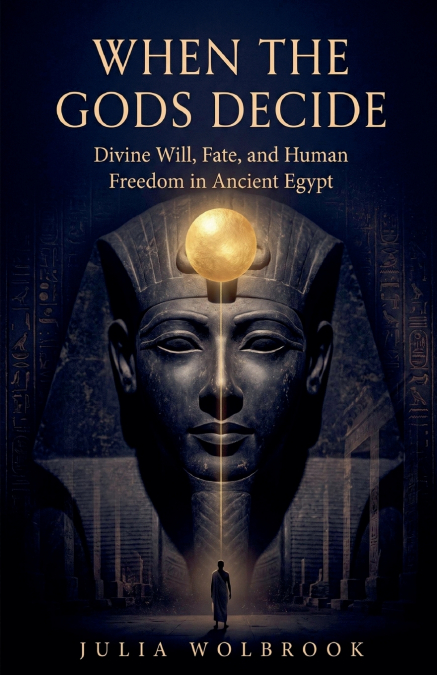
When the Gods Decide Divine Will, Fate, and Human Freedom in Ancient Egypt

When the Gods Decide Divine Will, Fate, and Human Freedom in Ancient Egypt

Julia Wolbrook

14,38 €
IVA incluido
Disponible
Editorial:
Serena Capuozzo
Año de edición:
2026
Materia
Filosofía occidental: antigua, hasta c. 500
ISBN:
9798235017672
14,38 €
IVA incluido
Disponible
Añadir a favoritos

Four thousand years before 'everything happens for a reason' became a comforting cliché, the Egyptians had already built an entire civilization around the question of who, or what, was really in charge of a human life.They believed a person’s fate was written the moment a midwife set them down on a birth brick. That a god’s hand could lift a beggar into a king’s court or cast a high priest into the street like a stray dog. That wealth, sickness, love, and the length of a life itself were gifts, or judgments, dispensed by powers no mortal could see, and few dared question.And yet they never stopped trying to bend that will anyway.They prayed to it. Bargained with it. Confessed to it, flattered it, and , when all else failed , threatened it. They built magic to fight the very fate their gods had decreed, wore amulets against demons that stalked the space between worlds, and inscribed their triumphs and their sins onto stone, hoping a god was somewhere listening.When the Gods Decide excavates this forgotten vocabulary of divine intervention , word by word, tomb by tomb, prayer by prayer , and follows it forward through the Bible, the Quran, and the proverbs still spoken on the streets of Cairo today. The result is not a dusty study of dead religion, but a strikingly intimate portrait of a question every human being has asked since the first grave was dug: how much of this life is truly mine to choose?The pharaohs are gone. The question never left.

Artículos relacionados

  • The Nature of Things
    Lucretius Lucretius
    De rerum natura (On the Nature of Things) is a 1st century BC didactic poem by the Roman poet and philosopher Lucretius with the goal of explaining Epicurean philosophy to a Roman audience. Lucretius presents the principles of atomism; the nature of the mind and soul; explanations of sensation and thought; the development of the world and its phenomena; and explains a variety o...
  • Pompeii
    Fergus Mason
    Pompeii was one of most advanced cities of its time; it had a complex water system, gymnasium, and an amphitheater. Despite it's advancements, there was one thing it wasn't ready for: Mount Vesuvius—the volcano that led to its ultimate doom.  The 79 AD eruption of Mount Vesuvius was one of the worst disasters in all of European history. In a near instant, over 15,000 p...
    Disponible

    10,36 €

  • Middle Platonism and Neoplatonism, Volume 1
    Stephen Gersh
    'It is generally agreed that those types of philosophy that are loosely called ’Platonic’ and ’Neoplatonic’ played a crucial role in the history of European culture during the centuries between antiquity and the Renaissance. However, until now no scholar has attempted to describe the evolution of these forms of thought in a single comprehensive academic study.' So writes Stephe...
  • Middle Platonism and Neoplatonism, Volume 2
    Stephen Gersh
    It is generally agreed that those types of philosophy that are loosely called 'Platonic' and 'Neoplatonic' played a crucial role in the history of European culture during the centuries between antiquity and the Middle Ages. However, until now no scholar has attempted to describe the evolution of these forms of thought in a single comprehensive academic study. Middle Platonism a...
  • Porphyry’s Commentary on Ptolemy’s Harmonics
    Andrew Barker
    ...
    Disponible

    80,87 €

  • The Roots of Platonism
    John Dillon
    ...
    Disponible

    26,54 €

Otros libros del autor

  • Rommel’s Ghost The Desert Fox, the Führer’s Favorite, and the Battle Over a Nazi General’s Legacy
    Julia Wolbrook
    He was the enemy the Allies couldn’t help but admire, and the propaganda machine that made him famous almost destroyed him.Erwin Rommel died in October 1944 a disgraced political liability, dismissed by Allied newspapers as just another Nazi thug. Six years later, Hollywood turned him into a celluloid hero, and his legend as history’s last honorable warrior has never really fad...
    Disponible

    16,44 €

  • Ink and Blood The Starr Family, the Treaty of New Echota, and the Cherokee Blood Feud That Followed the Trail of Tears
    Julia Wolbrook
    One signature. Three generations. A feud that bled across Indian Territory.On a winter night in 1845, two men slipped into a Cherokee politician’s home, found him asleep, and killed him in his bed. The murderers were brothers, and they were Starrs.To understand why, you have to go back seventy years, to a teenage Quaker trader who walked into the Cherokee mountains with an eye ...
    Disponible

    13,36 €

  • Madison County, Texas
    Julia Wolbrook
    Long before Madison County had a name, the Trinity River carried the Cenis and Bidai peoples, Spanish explorers, and French adventurers through the East Texas timberlands. Then came the settlers: peddlers, doctors, farmers, and families willing to bet everything on cheap land and cotton.Madison County, Texas, follows that story from its first Native homelands to the frontier co...
    Disponible

    13,40 €

  • The Superman Century Nietzsche’s Übermensch, Weimar Germany, and the Making of the Nazi Aryan Ideal
    Julia Wolbrook
    A lonely philosopher dreamed of a new kind of human being: free, fearless, and answerable to no one. Within fifty years, that dream had been claimed by feminists and Zionists, artists and pastors, soldiers in the trenches, and finally by Adolf Hitler.The Superman Century follows one idea through the most turbulent decades of modern Europe: from Nietzsche’s mountain solitude to ...
    Disponible

    16,52 €

  • Fathers of the Master Race Eugenics, the SS, and the Nazi Campaign to Breed a New Aristocracy of Blood
    Julia Wolbrook
    They could sterilize the 'unfit' by law. They could not order the 'fit' into the nursery.Adolf Hitler’s Germany promised a thousand-year Reich, but a thousand years demands heirs. To get them, the Nazis turned to a science that had been respectable in London, New York, and Berlin for half a century: eugenics.At the center of their plan stood Heinrich Himmler and his SS, the bla...
    Disponible

    14,47 €

  • Deal with the Devil Hitler, Stalin, and the Road to Barbarossa
    Julia Wolbrook
    In August 1939, two men who despised everything the other stood for shook hands and carved up Europe. For nearly two years, Nazi Germany and Soviet Russia traded oil for steel, territory for silence, while the world waited for the inevitable betrayal.Deal with the Devil unravels the secret diplomacy, mounting paranoia, and fatal miscalculations that turned an alliance of conven...
    Disponible

    14,44 €