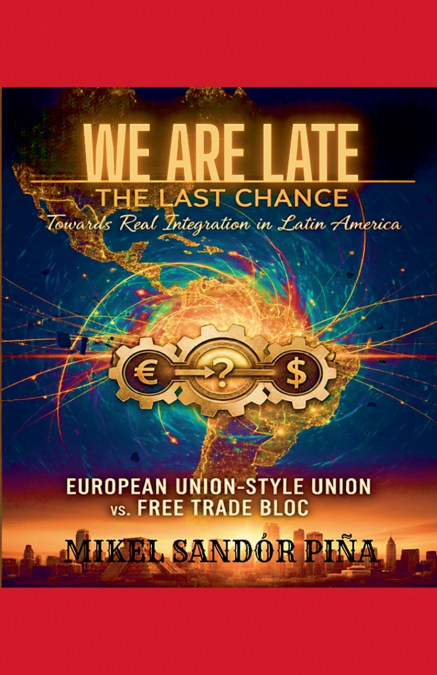
We Are Late

We Are Late

Mikel Sandór Piña

14,86 €
IVA incluido
Disponible
Editorial:
Mikel Sandór Piña
Año de edición:
2025
Materia
Macroeconomía
ISBN:
9798232680466
14,86 €
IVA incluido
Disponible
Añadir a favoritos

SYNOPSIS What is better for Latin America: a European Union-style Latin American union, or a free trade agreement that forms a solid economic bloc?'The Last Chance: Towards Real Integration in Latin America'What if Latin America could stop being a mosaic of frustrations and become a global power? What if the dream of regional integration wasn’t a utopia, but a pending roadmap?This book is not an ideological pamphlet nor a collection of good intentions. It is a technical, political, and strategic project to transform the destiny of a region that, for centuries, has had everything it needs to take off... except a shared vision.Through hard data, simulations, successful experiences, and historical warnings, 'The Last Chance' dissects the errors that have condemned Latin American integration to failure: symbolic blocs, toothless treaties, short-sighted leadership, and alliances that have included authoritarian regimes which sabotage from within.But it also offers a viable path: a model of progressive integration that starts with what is possible-like a solid free trade zone among reliable countries-and advances toward the ambitious: dignified regional mobility, a common digital currency, supranational governance, and a unified voice in global forums.Possible scenarios if the proposed model is applied:Positive Scenario (2045):Latin America operates with a logistics network connected by efficient trains and ports; a regional work visa allows for controlled movement of talent; and SMEs export under common rules with fair financing. The bloc negotiates with China, the US, and the EU as a single actor, while citizens access healthcare and education across borders.Intermediate Risk Scenario (2035):Integration advances only among democratic and reliable countries, while isolated dictatorships face sanctions and blockades. Benefits are concentrated in the 'reliable perimeter,' and social pressure forces institutional changes in the lagging countries.Failure Scenario (2029):A hasty attempt to integrate authoritarian regimes without filters collapses the bloc: courts are paralyzed, trade disputes arise with no solution, disorderly migration increases, and investor confidence evaporates. A new cycle of regional disillusionment sets in for decades.
Artículos relacionados

  • Introduction to Dynamic Macroeconomic General Equilibrium Models
    José Luis Torres Chacon
    This book offers an introductory step-by-step course in Dynamic Stochastic General Equilibrium modelling. Modern macroeconomic analysis is increasingly concerned with the construction, calibration and/or estimation and simulation of Dynamic General Equilibrium (DGE) models. The book is intended for graduate students as an introductory course to DGE modelling and for those econo...
    Disponible

    61,40 €

  • International Education and the Next-Generation Workforce
    Wei Wang
    Education is the first stage in developing a viable, dynamic, and long-lived global economy. Unfortunately, in times of economic hardship, educational programs, teacher salaries, and extracurricular opportunities are often the first to be cut. International Education and the Next-Generation Workforce: Competition in the Global Economy presents a detailed discussion of present e...
    Disponible

    236,17 €

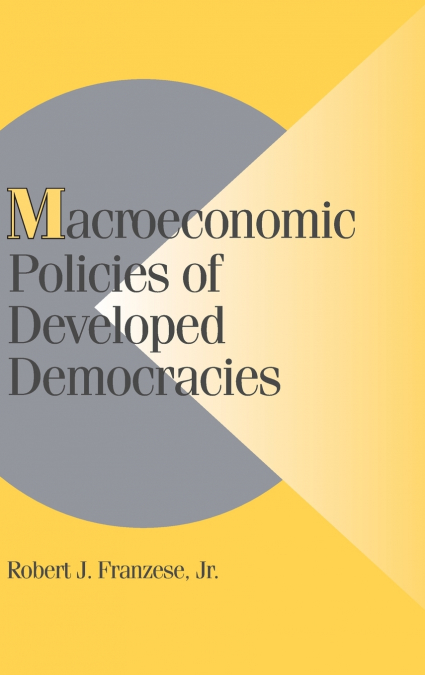
  • Macroeconomic Policies of Developed Democracies
    Robert J Franzese Jr
    ...
    Disponible

    113,93 €

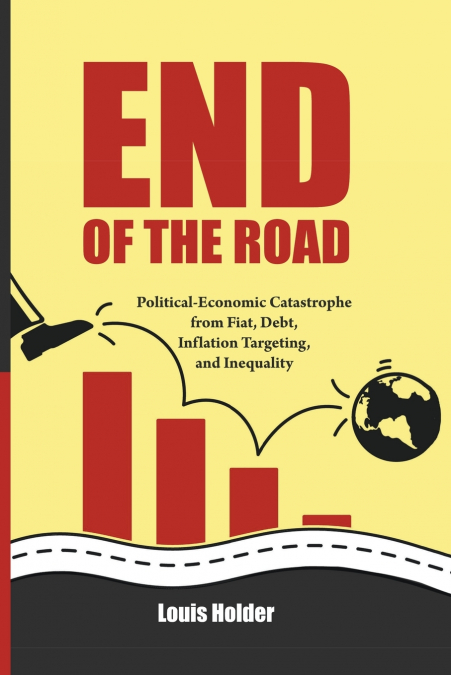
  • End Of The Road
    Louis Holder
    This book is about the mismanagement of Western economies in pursuit of political power, which resulting devastation will have to be borne by future generations. The book establishes that postponement is no longer doable and lays out the hard choices ahead causing much misery and agony.Although not fully recognized because of masking by asset bubbles, which are spun/sold as in...
    Disponible

    16,42 €

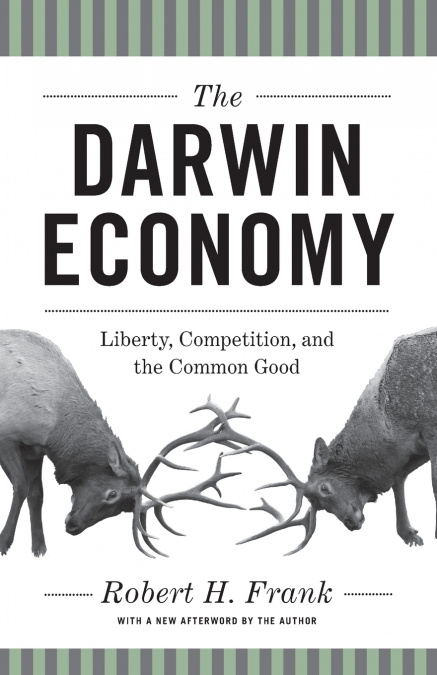
  • The Darwin Economy
    Robert H. Frank
    What Charles Darwin can teach us about building a fairer societyWho was the greater economist-Adam Smith or Charles Darwin? The question seems absurd. Darwin, after all, was a naturalist, not an economist. But Robert Frank, New York Times economics columnist and best-selling author of The Economic Naturalist, predicts that within the next century Darwin will unseat Smith as the...
    Disponible

    22,42 €

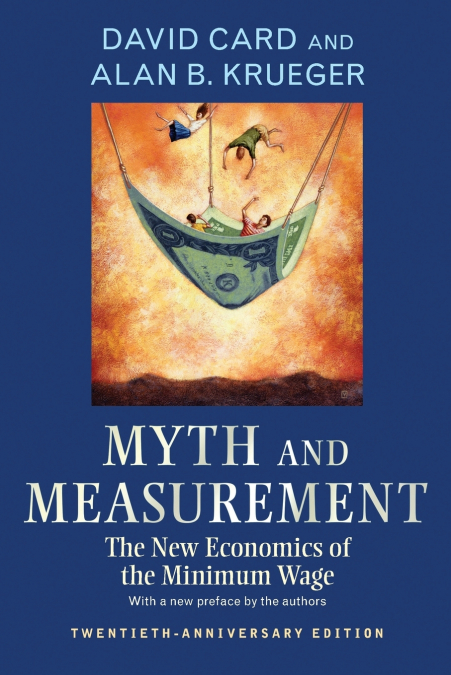
  • Myth and Measurement
    Alan B. Krueger / David Card
    From David Card, winner of the Nobel Prize in Economics, and Alan Krueger, a provocative challenge to conventional wisdom about the minimum wageDavid Card and Alan B. Krueger have already made national news with their pathbreaking research on the minimum wage. Here they present a powerful new challenge to the conventional view that higher minimum wages reduce jobs for low-wage ...
    Disponible

    39,64 €

Otros libros del autor

  • El Demonio de los Aranceles
    Mikel Sandór Piña
    Sinopsis 'EL DEMONIO DE LOS ARANCELES'Guerra de Aranceles: Una Guerra que Nadie Ganará Cuando las tarifas son trampas y los aliados, enemigos, el mundo entero arde.Esta no es solo una guerra entre EE.UU. y China: es un incendio global donde hasta los socios más cercanos se convierten en rivales. Canadá y México, atrapados entre aranceles a su acero y amenazas de romper el T-MEC...
    Disponible

    14,15 €