MD Ramon C. Henson
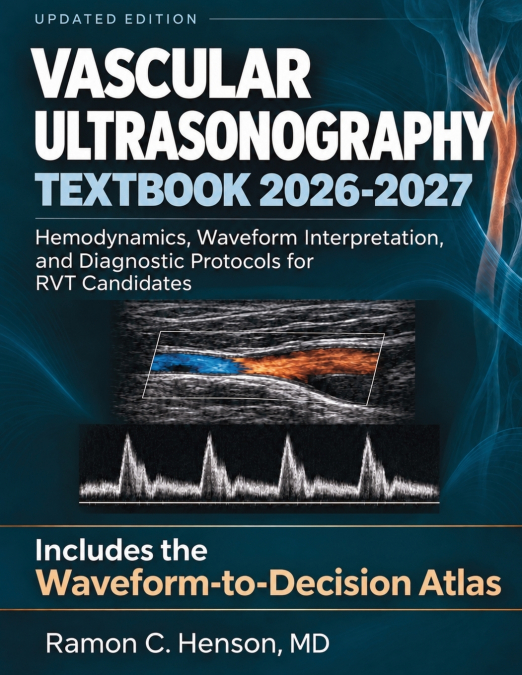
Translate Every Signal Into a Defensible Clinical Decision Vascular Ultrasonography Textbook 2026-2027 develops the full reasoning chain behind noninvasive testing: patient preparation, instrument control, anatomic localization, waveform validation, disease classification, reporting, surveillance, and urgent communication. Written for RVT candidates and working laboratory professionals, it connects physics with point-of-care interpretation across cerebrovascular, peripheral arterial, venous, visceral, dialysis-access, and postintervention examinations. The result is a practical framework for acquiring reproducible studies, recognizing discordant data, and reporting findings with calibrated certainty. Narrative clinical applications reinforce how symptoms, prior intervention, technical limitations, and multimodality evidence alter the meaning of a measured value or waveform pattern. Inside, readers develop the capability to: Optimize B-mode, color, power, and spectral controls - preserve diagnostic morphology while reducing artifact-driven errors Interpret arterial, venous, and physiologic signals - connect local waveform change with downstream consequence Execute territory-specific protocols - document carotid, intracranial, limb, aortic, visceral, reflux, and access studies consistently Evaluate reconstructions and devices - track bypass grafts, stents, endografts, dialysis access, and postprocedure complications Reconcile conflicting observations - distinguish technical limitation, physiologic variation, collateral flow, and true disease Communicate clinically important results - state location, severity, uncertainty, comparison, and urgency clearly Use the Waveform-to-Decision Atlas - move from signal pattern through technical validation to a clinical anchor Build a disciplined, reproducible approach to acquisition and interpretation for certification preparation and daily laboratory practice.