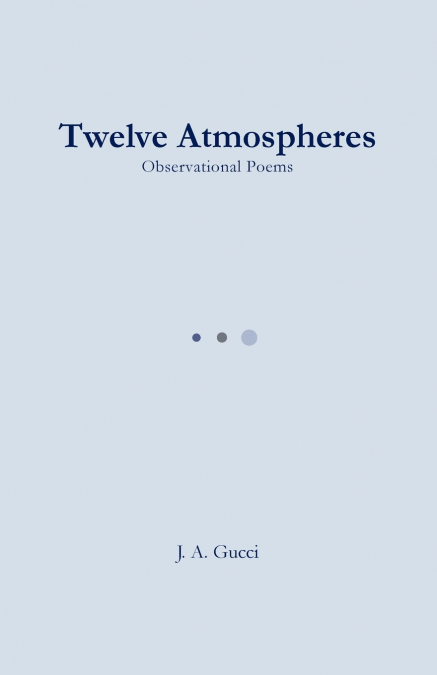
J. A. Gucci
Twelve Passes: A Structural Study of Artificial Intelligence - Instructor Edition provides a teaching and study framework for twelve poems examining structural correspondences between artificial-intelligence systems and independently observable natural processes.The sequence moves through twelve computational relations: text is segmented, represented, contextualized, weighted, transformed, carried forward, sampled, passed through a model, compared against an expected condition, propagated backward, revised, repeated, and brought toward convergence. The sequence is not intended as a complete account of every artificial-intelligence architecture or training procedure. Instead, it isolates recurring operations sufficiently stable for structural study.Each poem begins with a paradox triad drawn from artificial intelligence and places that relation in correspondence with an independently observable natural system. The operative relationship is:artificial-intelligence system → observable behavior ← natural systemNeither domain represents the other. A natural process does not become an allegory for machine learning, and a computational operation does not provide a symbolic interpretation of the physical world. Correspondence occurs only where the two systems exhibit compatible behavior while remaining materially and causally distinct.The Instructor Edition accompanies each poem with five areas of study: Natural System, AI System, Structural Correspondence, Absolute Composition, and Discussion. These sections verify the physical process underlying the composition, establish the relevant computational operation and necessary technical qualifications, examine shared observable behavior, identify compositional mechanisms, and provide questions for further study.Special attention is given to artificial-intelligence terminology that can carry misleading ordinary-language associations. Attention does not necessarily imply awareness. Prediction does not imply foresight. Error does not imply recognition of a mistake. Learning does not imply understanding. Weighting does not imply preference. Convergence does not imply intention or success. Within the systems examined here, these terms identify mathematical or computational operations.The poems were composed using Absolute Composition, a structural methodology developed by J. A. Gucci. Absolute Composition begins with observable behavior rather than symbolic equivalence and examines how systems divide, distribute, transform, retain, transmit, accumulate, revise, recur, and stabilize. Mechanisms and transitions may disappear from the page when their behavior remains structurally recoverable.Expanded appendices document the empirical phenomena and technical frameworks underlying the twelve passes, their compositional frameworks and structural mechanisms, and a taxonomy and system mapping of the twelve paradox triads. A glossary defines central terms from both artificial intelligence and Absolute Composition.Designed for classroom, scholarly, and independent study, the Instructor Edition treats its explanatory materials as structural documentation rather than answer keys. The purpose is not to convert compressed poems into explanatory diagrams, but to expose enough of their architecture for the structure itself to become teachable.