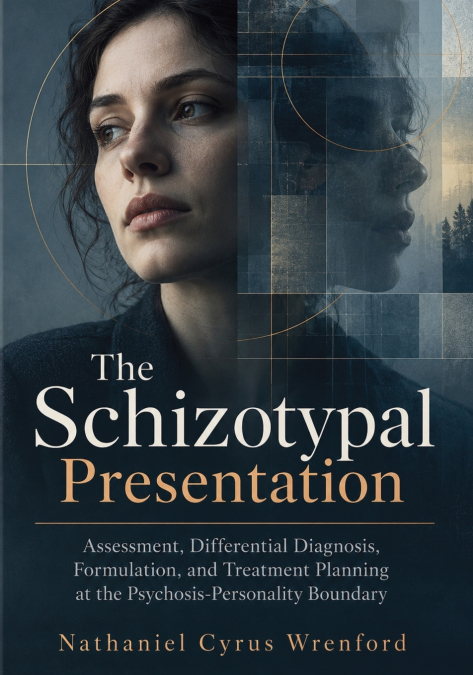
Nathaniel Cyrus Wrenford
When a presentation sits between personality pathology and psychosis, the difficult question is rarely whether a client has one unusual symptom. The real task is deciding what the pattern means, what else could explain it, whether it is changing, and what the clinician should do next. Schizotypal presentations can overlap with autism, obsessive-compulsive phenomena, trauma-related experiences, dissociation, social anxiety, other personality disorders, substance effects, and emerging psychosis. A practical guide to assessment and formulation The Schizotypal Presentation is a clinician-focused handbook for assessing schizotypal personality disorder, schizotypal disorder, dimensional schizotypy, and related psychosis-spectrum presentations. It helps readers move from symptom recognition to a structured clinical formulation by examining phenomenology, developmental course, reality testing, functional impact, differential diagnosis, risk, culture, treatment goals, and longitudinal change. Five clinical frameworks that organise difficult decisions The book uses five original practice frameworks: PRESENT for case formulation, ANCHOR for differential diagnosis, Baseline-Change-Threshold for psychosis monitoring, CLEAR for the clinical interview, and an Evidence-Calibrated Treatment Planning model. These tools are designed to support clinical reasoning, not replace validated assessment instruments, professional judgment, supervision, or specialist referral. Built around the questions clinicians actually face The discussion addresses how to explore ideas of reference, magical thinking, suspiciousness, unusual perceptual experiences, social detachment, disorganisation, and impaired functioning without reducing the client to a diagnostic checklist. It also examines key differentials, including autism, OCD, trauma, dissociation, schizophrenia-spectrum conditions, mood disorders, substance-related presentations, and culturally normative beliefs. Treatment chapters distinguish direct evidence from preliminary findings, evidence extrapolated from adjacent conditions, and general practice principles. This book is for readers who... This book is for clinical psychologists, psychiatrists, psychotherapists, counsellors, psychiatric nurses, social workers, and trainees who assess or treat complex personality and psychosis-spectrum presentations. It is also relevant to clinicians working in autism assessment, early psychosis, trauma services, personality-disorder services, and multidisciplinary mental health settings. If you want a practical clinician guide to schizotypal personality disorder, psychosis-spectrum assessment, differential diagnosis, case formulation, and treatment planning, this book offers a disciplined framework for making clearer, more defensible clinical decisions while preserving appropriate uncertainty.