MARISOL KESTRANDT
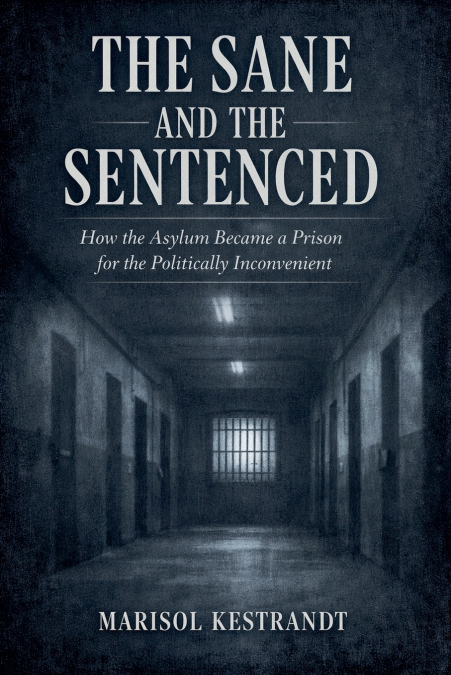
Viktoria Petrova called the war what it was. For that, a Russian court did not send her to prison. It sent her to a psychiatric hospital, with no release date attached.This has happened before. Vladimir Bukovsky knew it. So did Natalya Gorbanevskaya, who stood in Red Square with seven others and paid for it with a diagnosis instead of a sentence. So did the thousands of men and women who passed through Moscow’s Serbsky Institute, where a Soviet psychiatrist invented a disease called sluggish schizophrenia, a condition whose only detectable symptom was disagreeing with the government.The Sane and the Sentenced follows this weapon across a century and five continents. It begins in the euthanasia wards of Nazi Germany, where doctors first learned that a diagnosis could do what a bullet could not: erase a person’s claim to be heard. It follows the weapon into Mao’s China, where it survives today inside a network of police run hospitals called Ankang, peace and health, holding activists, petitioners, and practitioners of a banned spiritual movement. It follows the weapon into Ceausescu’s Romania, where a president said only madmen could question socialism, and meant it literally. It follows the weapon into an American hospital in rural Michigan, where a diagnosis once reserved for gentle, introspective patients was quietly redefined, over the course of a single decade, into a diagnosis for angry black men.And it follows the weapon home, into Russia today, where a United Nations investigator has confirmed what survivors of the Soviet system warned the world about decades ago. Punitive psychiatry has returned. The rate of forced psychiatric measures against Russian dissidents has multiplied since the invasion of Ukraine began. Belarus has disappeared dozens of its own citizens into psychiatric wards for the crime of protest. Iran now operates what state media calls hijab treatment clinics.This is not a book of abstractions. It is built from court records, United Nations reports, smuggled case files, and the testimony of the doctors and dissidents who survived what this book describes, several of whom paid for that survival with years of their own freedom. Dr. Semyon Gluzman wrote a manual teaching dissidents how to answer a psychiatrist without incriminating themselves, and served ten years for it. Dr. Anatoly Koryagin examined fifty five political prisoners and told the truth about every one of them, and was sentenced to hard labor for his honesty. Frances Ames spent eight years fighting South Africa’s medical establishment to hold two doctors accountable for the death of Steve Biko, and won.Their names deserve to be known. Their method, patient documentation, smuggled at extraordinary risk, deserves to be understood, because it is still the only thing that has ever worked.This book does not ask you to take its claims on faith. Every case, every statistic, every diagnosis quoted in these pages traces back to a named source. Nothing here has been invented for effect, because nothing here needed to be. The true history is more than enough.Read it in one sitting, because once Viktoria Petrova’s story catches you in chapter one, you will not want to put it down until you understand exactly how a government convinces a doctor that your convictions are a disease, and exactly what it has taken, again and again, across a hundred years, to make that government stop.