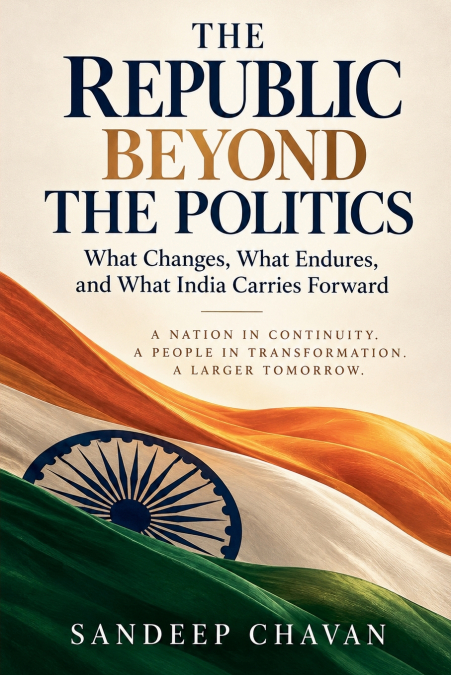
Sandeep Chavan
An election can change a government. But how much of the country changes with it?When India became independent in 1947, political sovereignty was transformed. Yet the new republic did not begin with a blank page. Laws, administrative practices, economic relationships, social divisions, and public institutions entered a new constitutional order. Some were retained, others reshaped, and many new arrangements were created in the decades that followed.In The Republic Beyond the Politics, Sandeep Chavan looks past the headlines of parties, elections, and political confrontations to examine the country that continues operating beneath them.How do governments change a system they have inherited? Why do some problems survive successive political eras while others are decisively resolved? What happens when development creates new expectations faster than institutions can meet them? And who bears the costs when reform is delayed, incomplete, or poorly implemented?Moving from the founding of the republic through linguistic state reorganization, political transitions, economic reform, federalism, public participation, and the everyday experience of institutions, the book investigates India’s capacity to adapt without assuming that every change is progress-or that every dispute signals crisis.Its perspective extends beyond India’s borders.Trade, technology, investment, medicines, energy, and strategic partnerships connect the quality of India’s domestic institutions with opportunities and risks across the world. International pressures, in turn, reshape India’s choices.With 2047 as an open horizon rather than a promised destination, this is neither a partisan verdict nor a prediction of India’s future. It is a serious, accessible investigation of what political power can change, what the republic continues to carry, and how today’s decisions become tomorrow’s inheritance.Written for readers interested in politics, history, governance, public policy, and international affairs, The Republic Beyond the Politics offers a wider perspective on the relationship between political change and national continuity.Governments come and go. The consequences remain-and the republic must keep working.