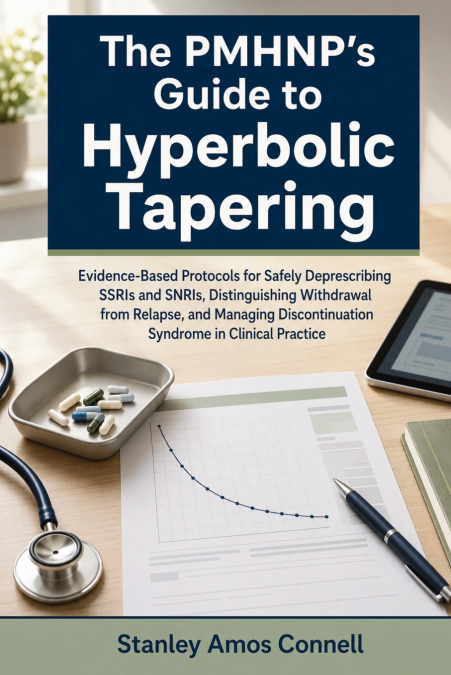
The PMHNP’s Guide to Hyperbolic Tapering

The PMHNP’s Guide to Hyperbolic Tapering

Stanley Amos Connell

18,81 €
IVA incluido
Disponible
Editorial:
Staten House
Año de edición:
2026
ISBN:
9798905992933
18,81 €
IVA incluido
Disponible
Añadir a favoritos

When a taper goes wrong, the chart usually records a relapse. A patient reduces their antidepressant, destabilises three weeks later, and returns to the original dose. They improve within four days. That improvement gets documented as confirmation that the medication was still needed. But recovery in four days is not how a depressive relapse behaves. It is how withdrawal behaves when the drug is restored, and the reasoning required to tell the difference is taught in almost no prescribing program. What this book does Hyperbolic tapering is now recommended in national clinical guidance, and knowing that it works does not tell a prescriber what to write on Tuesday afternoon. This book covers the part that comes after the theory: how to generate a proportional schedule from any starting dose, how to distinguish withdrawal from relapse in a fifteen minute follow up, where to obtain doses that no manufacturer produces, how to work with a compounding pharmacy, when to hold rather than reverse, and what a defensible chart note contains. Why this book is different Most tapering references are written for a mixed clinical audience and assume a formulary that does not match United States practice. This one is written for a single profession and a single supply chain. It teaches a method that generates schedules rather than supplying tables to copy, because the patients who most need help are the ones whose dose, drug, and history appear in nobody’s table. It also treats the current scientific disagreement about withdrawal seriously rather than picking a side, so that a clinician can answer the patient who arrives with a conflicting headline. Who this is for This book is for readers who prescribe antidepressants and were never taught how to stop them. It will suit psychiatric mental health nurse practitioners in independent, telehealth, or small group practice; nurse practitioner students working through a psychopharmacology sequence; physician associates and family practitioners managing long term antidepressant use in primary care; and clinical preceptors who supervise prescribing. A practical foundation Sixteen chapters take the reader from the receptor pharmacology through patient selection, informed consent, schedule arithmetic, formulation sourcing, monitoring, troubleshooting, special populations, documentation, and the practice structure required to deliver this work on a real caseload. If you want a clear and practical guide to deprescribing antidepressants in United States clinical practice, this book offers a structured place to begin.

Artículos relacionados

  • Genetic, Epigenetic, Environmental, and Pharmacological Models for Neuroscience, Neurologic Diseases, and Psychiatric Disorders
    Masaru Tanaka
    The Special Issue, 'Genetic, Epigenetic, Environmental, and Pharmacological Models for Neuroscience, Neurologic Diseases, and Psychiatric Disorders: Advancement in Bench-to-Bedside Translational Research,' delves into the complexities of neurological and psychiatric disorders, which affect millions worldwide. Despite advances, the etiology and pathogenesis of these disorders re...
  • Theories in Psychiatry
    Niall McLaren
    Psychiatry has to be taken seriously. An ever-increasing proportion of the population are prescribed long-term, powerful psychiatric drugs on opinions only, with no evidence of brain pathology. People who have broken no laws can be taken from their homes, locked in cells, stripped and drugged indefinitely, leaving them no practical means of regaining their civil rights. Niall M...
  • Commemorative Issue Celebrating the 20th Anniversary of the Alzheimer’s Foundation of America
    Alzheimer’s disease (AD) is a progressive neurodegenerative disorder that affects the lives of millions of people and their families around the globe. It results in a relentless decline in cognitive function, loss of judgment, change in personality, and neuropsychiatric and behavioral symptoms. Pathologic features characteristic of AD are deposition in the brain of two types of...
  • Better Than Prozac
    Samuel H. Barondes
    ...
    Disponible

    30,42 €

  • Life with a Partner or Spouse with Asperger Syndrome (ASD)
    Kathy Marshack
    'Going Over the Edge?' is a one-of-a-kind 'Asperger Syndrome' book on the Amazon best-seller list for books on Behavioral Disorders. The Anniversary Edition is one of a five-part series of Dr. Marshack’s books, 'ASPERGER SYNDROME' & Relationships: Five Books to Help You Reclaim, Refresh, and Perhaps Save Your Life.The Anniversary edition of Dr. Marshack’s classic has been augme...
    Disponible

    24,15 €

  • Single Session Thinking and Practice in Global, Cultural, and Familial Contexts
    Single Session Thinking and Practice teaches readers how to implement single session approaches by encouraging practitioners and clients to collaborate in making the most of every encounter. ...
    Disponible

    73,92 €

Otros libros del autor

  • Benzodiazepine Withdrawal Made Simple
    Stanley Amos Connell
    Stopping a benzodiazepine can be one of the hardest things a person does, and most people attempt it with very little reliable information. The symptoms are strange and frightening, the timelines run longer than anyone warned, and the loudest voices online often make the fear worse. This book replaces that confusion with clear, current understanding. What This Book Helps You Un...
    Disponible

    12,69 €