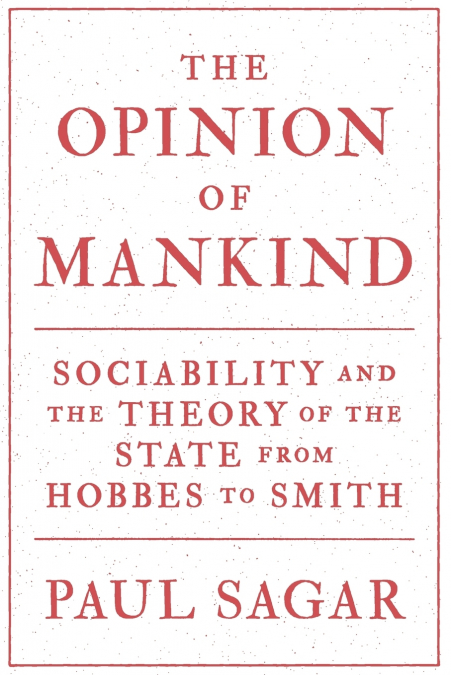
The Opinion of Mankind

The Opinion of Mankind

Paul Sagar

46,02 €
IVA incluido
Disponible
Editorial:
Princeton University Press
Año de edición:
2019
Materia
Filosofía social y política
ISBN:
9780691191515
46,02 €
IVA incluido
Disponible
Añadir a favoritos

How David Hume and Adam Smith forged a new way of thinking about the modern stateWhat is the modern state? Conspicuously undertheorized in recent political theory, this question persistently animated the best minds of the Enlightenment. Recovering David Hume and Adam Smith’s long-underappreciated contributions to the history of political thought, The Opinion of Mankind considers how, following Thomas Hobbes’s epochal intervention in the mid-seventeenth century, subsequent thinkers grappled with explaining how the state came into being, what it fundamentally might be, and how it could claim rightful authority over those subject to its power.Hobbes has cast a long shadow over Western political thought, particularly regarding the theory of the state. This book shows how Hume and Smith, the two leading lights of the Scottish Enlightenment, forged an alternative way of thinking about the organization of modern politics. They did this in part by going back to the foundations: rejecting Hobbes’s vision of human nature and his arguments about our capacity to form stable societies over time. In turn, this was harnessed to a deep reconceptualization of how to think philosophically about politics in a secular world. The result was an emphasis on the 'opinion of mankind,' the necessary psychological basis of all political organization.Demonstrating how Hume and Smith broke away from Hobbesian state theory, The Opinion of Mankind also suggests ways in which these thinkers might shape how we think about politics today, and in turn how we might construct better political theory.

Artículos relacionados

  • How Science Can Help Us Live In Peace
    Markolf H Niemz / James D Dunn
    Award-winning biophysicist Markolf H. Niemz puts into a nutshell what the top 3 scientists on earth have discovered. Charles Darwin: Animal and man are not two. Albert Einstein: Space and time are not two. Alfred N. Whitehead: The world and I are not two. The world we live in is non-dualistic. Nature is crying for peace, but we shut off foreign from native, poor from rich, othe...
    Disponible

    40,00 €

  • Sir George Tressady Vol.-II
    Mrs. Humphry Ward
    ' Sir George Tressady Vol. II' by Mrs. Humphry Ward is a unique that delves into the difficult social and political landscape of overdue nineteenth-century England. Mary Augusta Ward, writing beneath the pseudonym Mrs. Humphry Ward, become a prolific British creator known for her insightful portrayals of cutting-edge society. The narrative revolves across the imperative charact...
    Disponible

    15,20 €

  • Sir George Tressady Vol.-I
    Mrs. Humphry Ward
    'Sir George Tressady Vol. I' by Mrs. Humphry Ward is a unique that delves into the difficult social and political landscape of overdue nineteenth-century England. Mary Augusta Ward, writing beneath the pseudonym Mrs. Humphry Ward, become a prolific British creator known for her insightful portrayals of cutting-edge society. The narrative revolves across the imperative character...
    Disponible

    14,46 €

  • VIGLETS
    Viggo Hansen
    'VIGLETS Two - Ode to Dumbness' seeks to ease widespread global tensions resulting from dumb people, which includes everyone - and is seemingly increasing exponentially. The author gently guides readers into creating personal dumb Viglets - intimate odes, totally unrestricted by archaic rules of grammar - you simply let your emotions on dumbness 'hang out' and get instant relie...
    Disponible

    13,06 €

  • Crítica de la sociedad adultocéntrica
    Pedro Bravo Jorge Vásquez
    Crítica de la sociedad adultocéntrica constituye una reflexión sobre el carácter adultocéntrico de la sociedad contemporánea, por medio de la discusión con diversos autores importantes en el debate académico actual replantea perspectivas teóricas claves en la fundamentación de las subjetividades modernas. Para conseguir esto, el libro articula el análisis social recurriendo a l...
    Disponible

    20,80 €

  • Aristóteles, el juez y la equidad
    Eduardo Esteban Magoja / Eduardo Esteban Magoja
    La teoría de la equidad (epieíkeia) de Aristóteles es ese tipo de ideas que atraviesa la historia del pensamiento jurídico y que tiene una indudable incidencia en el quehacer interpretativo judicial. Sin embargo, es susceptible de diversas interpretaciones, resemantizaciones y apropiaciones, incluso por parte de cosmovisiones opuestas. En términos generales, se pueden identific...
    Disponible

    14,04 €

Otros libros del autor