DIPIKA SHARMA
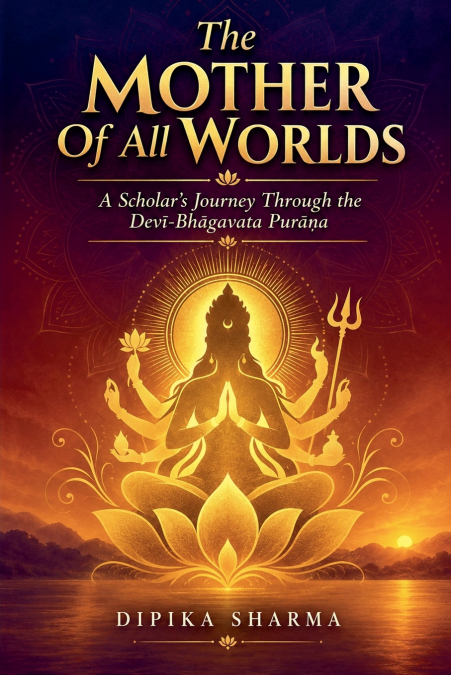
Long before philosophers argued over the nature of ultimate reality, a Sanskrit scripture had already answered the question in the boldest way imaginable: the ground of all existence is a Mother.The Devī-Bhāgavata Purana is one of Hinduism’s eighteen great MahāPuranas, nearly eighteen thousand verses across twelve books that most English readers have never had the chance to properly meet. Overshadowed for generations by its more famous namesake, the Vaishnava Bhāgavata Purana, this text makes a claim few scriptures anywhere dare make with such precision: that Brahman, the Supreme Reality, is best understood not as father or king, but as Devi, the Divine Mother, source and sustainer of the entire universe.The Mother of All Worlds is the first accessible, full-length English study guiding general readers through this remarkable text from beginning to end. Written by scholar Dipika Sharma in a voice rigorous without being dense, and warm without oversimplifying, this book unpacks where the Purana came from, what it says, and why it still matters.Inside, you will discover the quiet controversy at the heart of Hindu scripture, the centuries-old disagreement over which text truly deserves the name Bhāgavata, and how this Purana answers that question on its own terms. You will meet the Goddess in her many forms, from fierce Mahākālī to radiant Mahalaksmi to serene Mahāsarasvatī, and trace how regional goddesses across the subcontinent are gathered into one unified vision of the sacred feminine.You will travel through the mythic material scattered across all twelve books, from the birth of Pārvatī to the great gathering where the Purana is first recited. And at the center of the book, you will spend unhurried time with the Devī Gītā, the Song of the Goddess, a dialogue of striking philosophical depth in which Devi instructs the mountain king Himalaya on the nature of the self and liberation, in language that stands comfortably beside the Bhagavad Gita.Beyond myth and philosophy, this book explores the ritual world the Purana describes, the worship practices and sacred sites still observed today, before turning to its theology and its place alongside its two closest scriptural relatives. A final chapter asks what this ancient work still offers readers navigating questions of power, divinity, and the feminine sacred today.Whether you come to this book as a longtime devotee of the Goddess, a student of comparative religion, or simply a curious reader who has stood before an image of Durga or Kali and wondered about the story behind it, The Mother of All Worlds offers a clear, honest, deeply researched path into one of the most theologically daring texts in the Hindu canon.Scholarly in substance, accessible in style, and organized into nine focused chapters, this is the book English readers have long needed: a complete, faithful, genuinely readable introduction to the Devī-Bhāgavata Purana and the Goddess who stands, by its own testimony, at the very source of the world.