Vanheeswijck
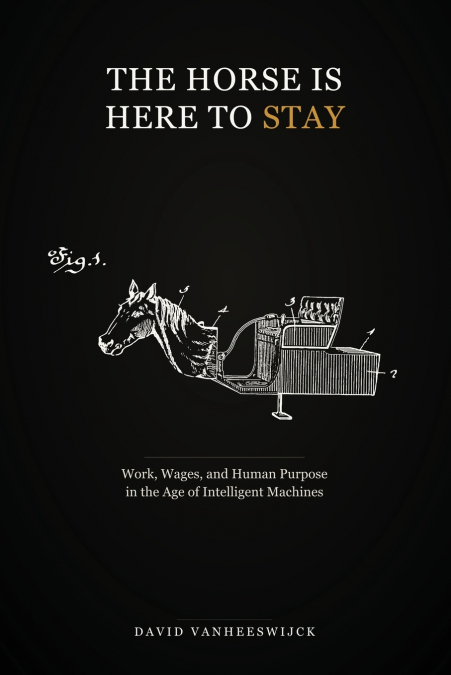
Somewhere a factory is running a full shift with the lights off. Not because the bulbs failed. Because no one is there who needs them. The output is real. The productivity is real. What has gone missing is the worker, and with the worker, the wage.For thirty years David Vanheeswijck wrote the software that let companies produce more without hiring more. The Horse Is Here to Stay turns that engineer’s view on the economy those systems are now building, and arrives at a conclusion most writing on AI avoids: the problem is not that machines will take the jobs. The problem is who owns the machines.The argument, in one line. The productivity gains from artificial intelligence are flowing to capital, not to labour, and this is not a law of physics. It is a design choice, renewed every quarter by institutions we have not bothered to update. In May 2026, Anthropic raised $65 billion at a valuation near a trillion dollars; weeks later, Alphabet guided to roughly $185 billion of AI-driven capital spending in a single year. Not one line in either balance sheet reserves a claim for the workers whose tasks those systems are being trained to perform.Why this book is different. It refuses both of the comforting stories. It is not a warning about robots, and it is not a manifesto for a workless utopia funded by a universal cheque. The case it makes is that redistribution, taxing the winners after the fact and handing the proceeds down, is the wrong instrument. It leaves ownership exactly where it is and asks the political system to claw back the gains forever. The alternative is predistribution: changing who owns the productive assets before the returns are extracted, so that citizens hold a stake in the output rather than a floor beneath them.What the book works through. It starts with the evidence that pay and productivity came apart fifty years ago, long before AI, and that AI is the perfection of that older mechanism rather than its cause. It examines the new micro-giants, firms generating millions of dollars in revenue per employee, and what they reveal about the collapsing link between work and value. It takes the governance problem seriously: when three asset managers vote a fifth of every large American company, ownership is already concentrated in ways the law never anticipated. It studies the two places on earth where citizen ownership works at scale, Norway’s sovereign fund and the Alaska Permanent Fund, and is honest about what they can and cannot teach the rest of us. And it asks the question the technical fixes never reach: what people are for, once income is no longer the thing that organises a life.The book takes its title from the early automobile, built to look like a horse carriage so it would not frighten its owners. The Horsey Horseless, a machine wearing a horse’s face. We are making the same mistake with the most powerful productivity technology in history, governing it with the institutions of the industrial age and hoping the resemblance holds.Vanheeswijck writes as an engineer, not an economist, and that is the point. The diagnosis comes from inside the machine, from someone who built the pipelines and the automation the argument is about. The result is concrete where this debate is usually abstract, and specific where it is usually consoling.The window for predistribution is open now, while the assets are still being assembled and the ownership is still being decided. It will not stay open. The Horse Is Here to Stay is the argument for walking through it before it closes.