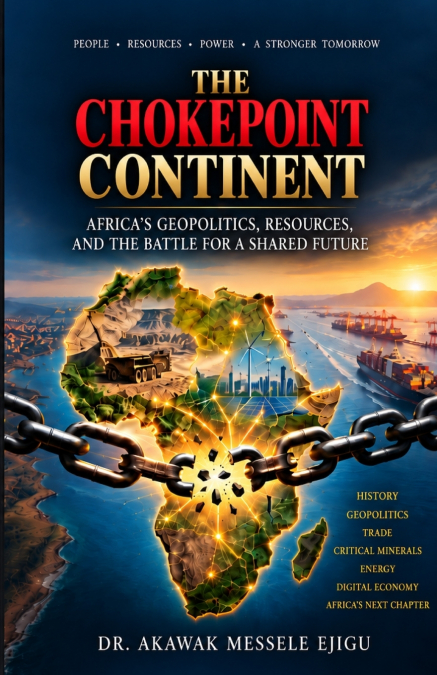
The Chokepoint Continent

The Chokepoint Continent

Akawak Messele Ejigu

17,53 €
IVA incluido
Disponible
Editorial:
Indy Pub
Año de edición:
2026
Materia
Economía del desarrollo y economías emergentes
ISBN:
9798349442261
17,53 €
IVA incluido
Disponible
Añadir a favoritos

Relevance Is Not PowerAfrica supplies many of the resources the modern world depends on-minerals essential to electric vehicles, renewable energy, telecommunications, and defense. Its forests shape global climate policy. Its population represents one of the largest future labor forces and consumer markets. Its ports, digital users, and strategic geography influence governments and corporations worldwide.Yet Africa rarely controls the systems that turn those assets into wealth and influence. Minerals come from African soil, but prices are set on exchanges elsewhere. African users generate vast data, but the platforms and algorithms extracting value from it are controlled abroad. African forests produce valuable carbon assets, while external institutions define how they are measured, certified, and priced.Africa matters. But mattering is not governing.In The Chokepoint Continent, Dr. Akawak Messele Ejigu explains why Africa’s growing global importance has not produced proportional power. Possession alone does not create leverage. A country may control a valuable mineral, a major port, or a critical ecosystem and still remain dependent if others control the systems through which that asset moves.Those systems are the chokepoints: commodity exchanges, refining networks, payment rails, cloud platforms, shipping corridors, standards bodies, carbon registries, arbitration forums, and debt calendars. Less visible than mines and pipelines, they determine who sets the price, controls timing, grants access, and writes the rules.The book identifies four forms of leverage: Positional-controlling something scarce and hard to replace. Architectural-controlling the system through which others must operate. Temporal-the capacity to wait and negotiate without forced concessions. Admissibility-controlling standards and regulations that determine access.Africa holds significant positional leverage. The challenge is converting that position into architecture, protecting it with time, and extending it into rule-making authority.The book traces how the present system was built-from colonial extraction corridors and structural adjustment to global finance, digital platforms, and infrastructure competition-showing how formal sovereignty can coexist with operational dependence.But this is no book of fatalism. It does not argue Africa is powerless or that all foreign engagement is exploitation. African governments have agency. Some have built institutions that convert resources into bargaining power. Others have traded long-term control for short-term revenue.The decisive question is not whether Africa should participate in global markets, but whether participation builds African capacity-or merely expands African activity inside systems governed by others.The book offers a practical doctrine: identify what others cannot easily replace, build the systems through which that value moves, extend financial and political time horizons, and gain influence over rules of entry. That means investing not only in roads and mines, but in laboratories, data centers, payment systems, geological intelligence, regulatory institutions, regional markets, and standards bodies.The Chokepoint Continent is a sharp examination of hidden global power architecture-and a strategic argument for how Africa can move from relevance to leverage, from participation to authority, and from supplying the world to helping set its terms.
Artículos relacionados

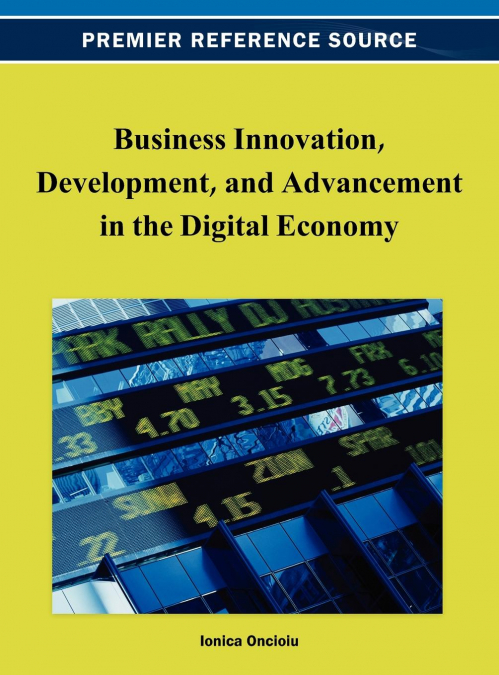
  • Business Innovation, Development, and Advancement in the Digital Economy
    Oncioiu
    Digital technologies maintain an important tool in today’s business economy. As the economy continues to change, businesses seek out solutions in order to enhance and develop their organization. Business Innovation, Development, and Advancement in the Digital Economy highlights the competitive advantages on the emerging digital economy. Bringing together the classic economy the...
  • Green Technology Applications for Enterprise and Academic Innovation
    Ezendu Ariwa
    In the age of corporate responsibility, green technology and sustainability continue to grip the consciousness of business and academic institutions. However, development of appropriate business-driven green applications requires an awareness of best practices of the green agenda. Green Technology Applications for Enterprise and Academic Innovation addresses the importance of g...
  • Bridging the Gap Between Growth Theory and Policy in Asia
    Rup Singh / Tatla Dar Singh
    Although economic growth is amongst the oldest of debates in Economics, there has been little advancement in growth theory since the classic works of Solow. As such, clear-cut answers to the context-specific determinants of growth, especially for developing countries, are rare. Bridging the Gap Between Growth Theory and Policy in Asia: An Extension of the Solow Growth Model add...
  • Comparative Economics and Regional Development in Turkey
    Bryan Christiansen / MMustafa Erdoğdu
    The rise of globalization has affected the ways in which nations maintain sustainable development and economic prosperity. Certain countries, such as Turkey, have evolved into a place of particular importance in the changing global economy. As such, it has become more important than ever to better understand the crucial role of such nations on an international scale. Comparativ...
  • Global Perspectives on Trade Integration and Economies in Transition
    Vasily Erokhin
    In the era of globalization, foreign trade has an immense impact upon modern economies. To succeed in the global marketplace, sustainable development in trade practices is an imperative goal for countries to reach. Global Perspectives on Trade Integration and Economies in Transition is an authoritative reference source for the latest research on the dynamics of transitional eco...
  • The African Union and New Strategies for Development in Africa
    The early twenty-first century witnessed remarkable attempts by Africa’s political leadership to promote regional integration as a means of fast-tracking economic progress, facilitating peace and security, consolidating democratic gains, and promoting the general welfare of the African people. The transition of the Organization of Unity (OAU) to the African Union (AU), as well ...

Otros libros del autor

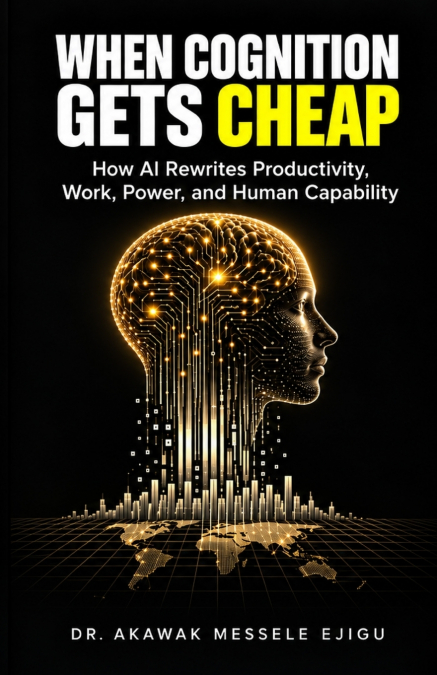
  • WHEN COGNITION GETS CHEAP
    Akawak Messele Ejigu
    What happens when intelligence is no longer scarce?Artificial intelligence is doing more than automating tasks. It is driving down the cost of cognition itself-the cost of generating ideas, analyzing information, coordinating activity, solving problems, and supporting decisions.When Cognition Gets Cheap examines what follows when these capabilities become dramatically more abun...
    Disponible

    24,98 €

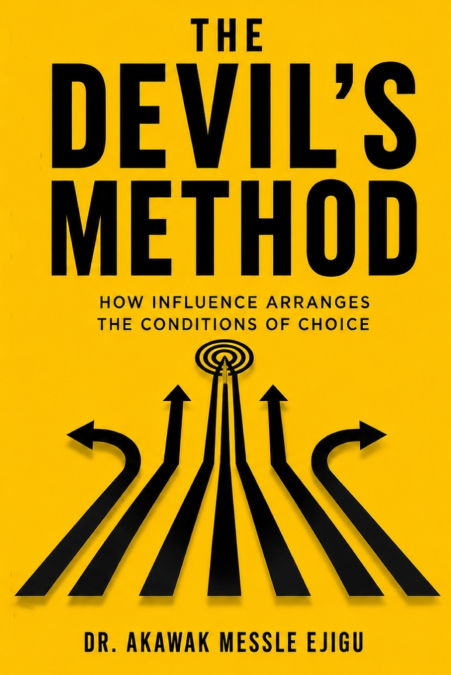
  • THE DEVIL’S METHOD
    Akawak Messele Ejigu
    THE DEVIL’S METHODHow Influence Arranges the Conditions of ChoiceWhat if the most powerful form of influence does not tell you what to choose-but quietly arranges the conditions from which your choice makes sense?We like to believe that our decisions belong to us. We weigh the evidence, consider our options, and choose.But influence often begins earlier.The information availabl...
    Disponible

    21,41 €

  • LE CONTINENT DES POINTS D’ÉTRANGLEMENT
    Akawak Messele Ejigu
    L’importance n’est pas le pouvoirL’Afrique fournit une grande partie des ressources dont dépend le monde moderne : minerais stratégiques, forêts, marchés, données, ports et corridors essentiels. Pourtant, elle contrôle rarement les systèmes qui transforment ces atouts en richesse, en influence et en pouvoir.Les minerais viennent du sous-sol africain, mais les prix sont souvent ...
    Disponible

    19,59 €