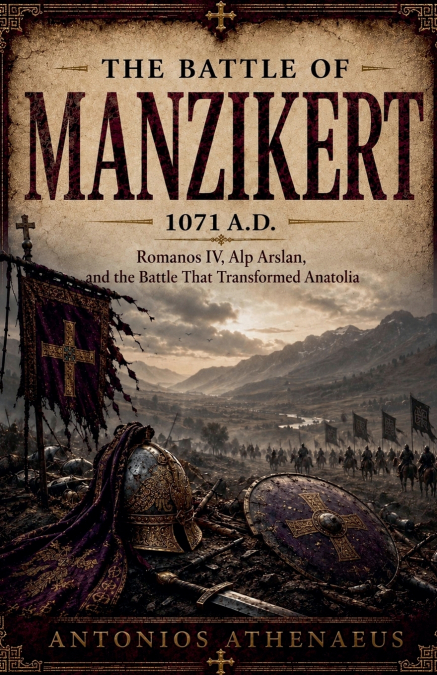
The Battle of Manzikert 1071 A.D.

The Battle of Manzikert 1071 A.D.

Antonios athenaeus

23,28 €
IVA incluido
Disponible
Editorial:
Antonios athenaeus
Año de edición:
2026
Materia
Estrategia, planificación e investigación defensivas
ISBN:
9798232097936
23,28 €
IVA incluido
Disponible
Añadir a favoritos

At Manzikert, the struggle for the eastern frontier became a crisis that would transform the future of Byzantium.In 1071 A.D., Emperor Romanos IV Diogenes led a major imperial army across Anatolia to recover Manzikert and Khliat and restore Byzantine control near Lake Van. While Romanos advanced from the west, the Seljuk sultan Alp Arslan abandoned his campaign in Syria and moved rapidly north toward Armenia. Their armies converged outside Manzikert in one of the most consequential battles of the medieval world.This book examines Manzikert not simply as a famous Byzantine defeat, but as a campaign shaped by intelligence, logistics, divided forces, mobility, command, and battlefield cohesion. Romanos commanded a powerful but heterogeneous army whose strength depended upon maintaining formation and forcing close combat. Alp Arslan relied upon mounted archers, mobility, and control of distance to avoid the decisive engagement the Byzantines sought.The battle unfolded gradually. As Romanos advanced south, the Seljuks conducted a controlled fighting withdrawal, using missile fire and repeated harassment to stretch the imperial formation. Late in the day, Romanos ordered a countermarch toward Manzikert. The difficult maneuver created the opportunity Alp Arslan had been waiting for. Seljuk cavalry attacked, the Byzantine right collapsed, the reserve failed to restore the line, and the emperor was increasingly isolated as the army broke apart.Romanos remained with the surviving troops around the imperial standard until his horse was killed, he was wounded, and the last organized resistance was overwhelmed. His capture was extraordinary-but Manzikert did not immediately destroy the Byzantine army or hand Anatolia to the Seljuks. The deeper disaster followed when political rivalry, civil war, and the overthrow of Romanos prevented the empire from recovering effectively from defeat.Drawing upon medieval sources and modern military scholarship, this study reconstructs the campaign and battle through detailed analysis of:• Romanos IV’s eastern campaign and strategic objectives• The opposing Byzantine and Seljuk armies• The division of the imperial force near Lake Van• Terrain, deployment, and battlefield maneuver• The Byzantine advance and Seljuk fighting withdrawal• The countermarch and collapse of the imperial line• Romanos IV’s final resistance and capture• Tactical maps and battlefield diagrams• The political and strategic consequences of defeat• Lessons in command, cohesion, mobility, and operational decision-makingWritten for readers of military history, strategy, Byzantine warfare, and medieval conflict, The Battle of Manzikertexplains how a formidable imperial army lost control of the battlefield-and how a serious military defeat became the beginning of a far greater political and strategic crisis.Manzikert was not simply the defeat of Romanos IV. It was the battle that exposed the fragility of Byzantine command and helped transform the future of Anatolia.

Artículos relacionados

  • Inconspicuous
    Wes Choc
    This is about how an unplanned encounter by the author evolved into a worthy story ...a life story about how a young Walter Rothwell, born in the US, grew up in Switzerland and became fluent in four languages by the time he was ...drafted in the US Army during World War II.  Being drafted the same month that the war ended might seem fortuitous, but because of his shrewd languag...
    Disponible

    12,00 €

  • On War (Complete edition translated by J. J. Graham)
    Carl von Clausewitz / J. J. Graham / JJGraham
    Carl von Clausewitz entered the Prussian military at the age of twelve as a Lance-Corporal and would go on to obtain the rank of Major-General. In “On War”, Clausewitz draws upon his experiences fighting in the French Revolution and Napoleonic Wars, as well as his military studies at the “Kriegsakademie”, or Prussian War Academy, which he would eventually become director of. Cl...
    Disponible

    24,61 €

  • On War
    Carl Von Clausewitz
    Unabridged value reproduction of the most critical and thought provoking first four books of “On War” by Carl von Clausewitz, translated by J.J. Graham, and including footnotes. These books give the theory and goals of war that can be applied to conquering meeting rooms and empires. This volume of On War includes topics of the Nature, Theory, and Strategy of War and Combat.Thes...
  • The View From First Mountain
    William G. Hanne / William GHanne
    The Croatian War of Independence ended with the success of Operation Storm on August 7, 1995.  Less than five months later, Bill Hanne found himself part of the Democracy Transition Long Range Management Program and packing for Zagreb.  With his background in military intelligence, plus graduate degrees in political geography and education policy and planning, Dr. Hanne brought...
    Disponible

    35,53 €

  • Short Timer
    Richard A. Henry
    Short-Timer is a small part of the history of the Vietnam War; America’s longest war where for the first time, men of every ethnic background and color fought together side by side in fully integrated units. It is the story of one individual’s survival in a war where flashing the peace sign was perfectly acceptable, while waving a clinched fist in the air, the Black Power symbo...
    Disponible

    16,32 €

  • Combined Arms Warfare in the Twentieth Century
    Jonathan M. House
    For centuries, the world has witnessed the development and use of increasingly complex and powerful military systems and technologies. In the process, the 'art of war' has truly become the art of combined arms warfare, in which infantry, artillery, air support, intelligence, and other key elements are all coordinated for maximum effect. Nowhere has this trend been more visible ...
    Disponible

    38,99 €

Otros libros del autor

  • The Siege of Syracuse 414-413 B.C.
    Antonios athenaeus
    The Siege of Syracuse was the campaign that destroyed one of the greatest military expeditions ever launched by Athens.In 415 B.C., at the height of the Peloponnesian War, Athens dispatched an immense armada to Sicily. What began as an ambitious attempt to expand Athenian power soon became a two-year struggle for Syracuse, the most powerful Greek city in Sicily. By 413 B.C., th...
    Disponible

    23,19 €

  • The Battle of Megalopolis 331 B.C.
    Antonios athenaeus
    The Battle of Megalopolis was Sparta’s last great attempt to break Macedonian supremacy in Greece.In 331 B.C., while Alexander the Great was campaigning deep within the Persian Empire, King Agis III of Sparta launched a major revolt against Macedonian rule. After years of preparation and diplomacy, Agis gathered Spartan, Peloponnesian, and mercenary forces to challenge the poli...
    Disponible

    23,29 €

  • The Battle of Tegyra 375 B.C.
    Antonios athenaeus
    The Battle of Tegyra marked the first open-field defeat of a Spartan army by a smaller Greek force.In 375 B.C., only four years before the decisive Battle of Leuctra, Pelopidas led a small Theban force against Orchomenus, hoping to exploit the temporary absence of its Spartan garrison. Forced to abandon the operation after learning that reinforcements had already entered the ci...
    Disponible

    23,28 €

  • The Battle of Nineveh 627 A.D.
    Antonios athenaeus
    At Nineveh, the fate of the Sasanian Empire-and the survival of the Eastern Roman Empire-was decided.In 627 A.D., Emperor Heraclius led one of the most daring campaigns of Late Antiquity deep into the heart of the Sasanian Empire. Refusing to remain on the defensive after years of devastating Persian invasions, he carried the war across Armenia into northern Mesopotamia, forcin...
    Disponible

    22,71 €

  • The Battle of Coronea 394 B.C.
    Antonios athenaeus
    The Battle of Coronea marked the moment Sparta preserved its supremacy against the greatest challenge of the Corinthian War.In 394 B.C., only weeks after the Battle of Nemea, King Agesilaus II returned from his victorious campaign in Asia Minor to confront the growing anti-Spartan coalition in Boeotia. Determined to prevent his enemies from uniting their full strength, he march...
    Disponible

    23,08 €

  • The Battle of Nemea 394 B.C.
    Antonios athenaeus
    The Battle of Nemea marked Sparta’s dramatic return to dominance at the opening of the Corinthian War.In 394 B.C., the greatest coalition assembled against Sparta since the Persian Wars confronted the Peloponnesian army on the plains of Nemea. Athenians, Boeotians, Corinthians, Argives, and their allies sought to end Spartan supremacy. Instead, they encountered one of the fines...
    Disponible

    23,15 €