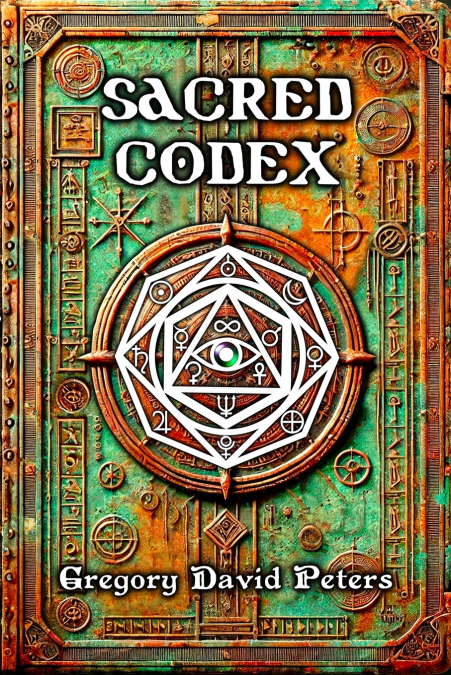
Gregory David Peters
THE WORLD DOES NOT STAND STILL FOR WISDOM.What protects us can become what confines us. What brings success can eventually bring ruin. A strength carried beyond its proper measure can become a weakness, while an apparent limitation may preserve possibilities that unlimited freedom would destroy.The difficulty is not merely knowing what works. It is recognizing when the conditions that made something wise have changed.What happens when the right answer outlives the question?Inspired by two of Eastern philosophy’s most enduring works, the Tao Te Ching and the I Ching, Tao of Logic is an original philosophical exploration of existence, transformation, and the invisible relationships through which reality takes shape.Across 1,165 original philosophical discourses, Gregory David Peters brings ancient wisdom into conversation with independent reason, metaphysical inquiry, and the contradictions of human experience.Beginning with The Logic of Tao, an opening meditation on the unseen relationships that allow an arch to stand, the book examines a fundamental paradox of existence: things can possess qualities that belong neither to their individual parts nor to their parts considered in isolation.A person is more than a body. A civilization is more than its people. A life is more than the events it contains. What sustains a thing may remain invisible until the relationships holding it together begin to fail.From this foundation, the inquiry unfolds through eight interconnected books:Earth Before Eden. Mountain and the Mind. Water and Wisdom. Wind and Leaves. Fire and Shadows. Thunder and Silence. Lake of Fire. Heaven and Here.Each explores a different dimension of existence-origin and becoming, perception and identity, adaptation and restraint, influence and consequence, knowledge and illusion, conflict and transformation, harmony and belonging, mortality and the infinite.Here, strength is examined alongside its limitations. Humility does not require surrendering agency. Harmony need not demand agreement. A principle must survive examination, not merely sound profound. Even victory must answer for what it destroys, and even wisdom must remain capable of discovering its own mistakes.Through aphorisms, paradoxes, analogies, and philosophical arguments, Tao of Logic challenges the assumptions beneath our understanding of freedom, power, desire, certainty, morality, time, and change.What makes a life strong without making it rigid?When does preservation become captivity?Can something remain itself while everything composing it changes?How much of what we call control depends upon conditions beyond our control?What does it mean to act wisely when every action changes the world in which its consequences must unfold?Neither a conventional self-help book nor a doctrine offering answers to be memorized, Tao of Logic invites a different kind of attention: the willingness to examine not only what we believe, but the relationships, limitations, and changing circumstances that give those beliefs their meaning.Because understanding reality is not the same as mastering it.And the deepest wisdom may begin where the desire for mastery ends.TAO OF LOGICGregory David PetersFOURTH INITIATE DISCOURSES Vol. IIQuestion. Examine. Become.