Lozelle Lenoir
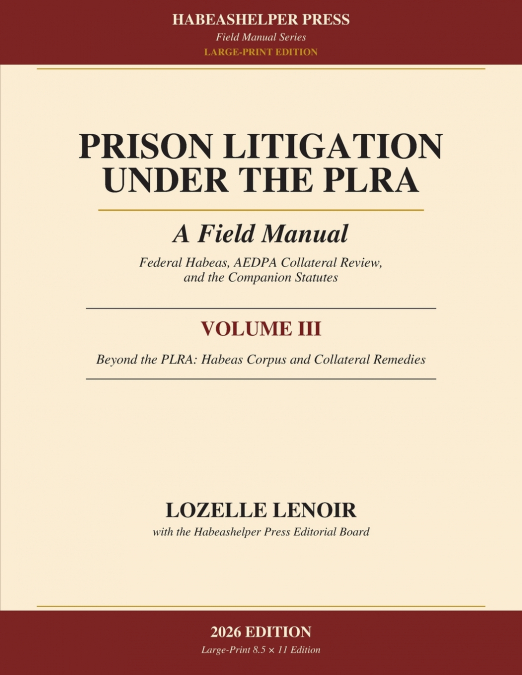
Volume I of the Habeashelper Press PLRA Field Manual mapped the Prison Litigation Reform Act’s procedural gates. Volume II treated the substantive merits of § 1983 and Bivens conditions cases. Volume III turns to the parallel track: federal habeas corpus, AEDPA collateral review, and the companion statutes practitioners plead alongside § 1983 and § 2254 every working week.Thirty-one chapters trace the doctrine end to end. Part One - the custody/conditions divide - walks the Preiser v. Rodriguez line through Heck v. Humphrey, Edwards v. Balisok, Muhammad v. Close, Nelson v. Campbell, and Wilkinson v. Dotson, and reduces the framework to a working decision tree. Part Two treats § 2254 habeas for state prisoners under AEDPA: the one-year limitations clock and its tolling rules; exhaustion and fair presentation; procedural default and its exceptions; the § 2254(d) deference standard; evidentiary hearings under § 2254(e)(2); ineffective-assistance and other substantive grounds; second or successive petitions; and certificates of appealability. Part Three treats federal post-conviction relief: § 2255 motions, second or successive § 2255 motions, the § 2255(e) savings clause as reshaped by Jones v. Hendrix (2023), and § 2241 sentence-execution practice. Part Four treats the companion statutes - RLUIPA, the ADA and Rehabilitation Act, RFRA, the Federal Tort Claims Act, and the First Step Act. Part Five closes with immigration detention, private prisons and contractor liability, juveniles in adult facilities, civil commitment, a thirty-year retrospective on the PLRA and AEDPA, and a practitioner’s strategy chapter tying all three volumes together.Fourteen appendices follow: an AEDPA limitations flowchart; a procedural-default analysis template; annotated sample § 2254, § 2255, and § 2241 petitions; an FTCA SF-95 administrative-claim checklist; a compassionate-release motion template; RLUIPA and ADA-accommodation complaint templates; a Preiser/Heck decision tree; a habeas glossary; a table of cases; a table of statutes; and - closing the three-volume set - a consolidated subject-matter index across Volumes I, II, and III. Every cited case, statute, and regulation has been verified against the published reporter or the United States Code. Primary audience: prisoners’ lawyers, criminal-defense and civil-rights practitioners, federal-defender offices, clinical professors and students, court staff attorneys, and pro se litigants with prior federal-court exposure.