Sandeep Chavan
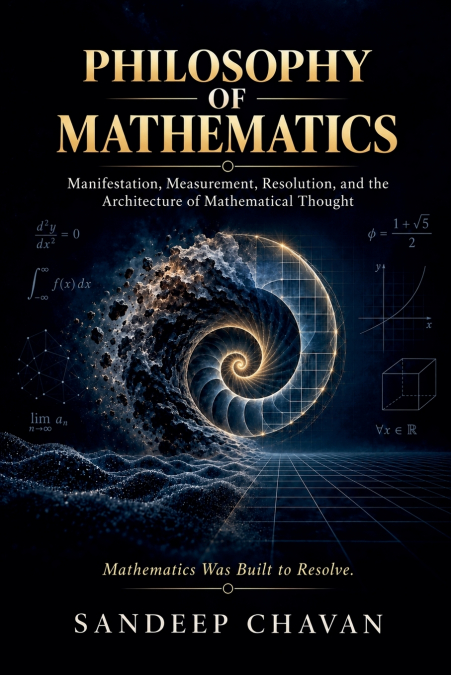
What is mathematics actually doing?Is mathematics discovered or invented? Why does it describe nature so successfully? Is a mathematical truth also a physical truth? What happens when equations describe possibilities that have never manifested? And why do so many learners encounter mathematics as symbols before they understand the relations those symbols were built to carry?In Philosophy of Mathematics, Sandeep Chavan approaches these questions developmentally rather than beginning with a verdict about what mathematics ultimately 'is.'The journey begins before number.A difference becomes recognizable. Comparison appears. Measurement stabilizes it. Number compresses multiplicity. Geometry preserves spatial relation. Algebra makes relation portable. Calculus makes continuous change calculable. Symbols and equations then compress these structures until mathematics becomes capable of operating increasingly within its own formal architecture.The book develops a larger sequence:Manifestation → Delta → Awareness → Recognition → Comparison → Measurement → Relation → Abstraction → Representation → Operation → Calculation → Formal Consequence → Prediction → Verification or Application → Changed ManifestationFrom this architecture emerge several central distinctions:Mathematics preserves structure; manifestation carries occurrence.Mathematical consequence is not automatically physical consequence.Mathematical existence and manifested existence are different claims.The book revisits the traditional debate over whether mathematics is invented or discovered and proposes a layered alternative: humans discover relational constraints and construct mathematical architectures through which those constraints can be represented and resolved. Once constructed, those architectures generate further consequences that can themselves be discovered.Using examples ranging from F = ma and E = mc² to Euler’s identity, Maxwell’s equations, the Schrödinger equation, Einstein’s field equations, and Boltzmann’s entropy relation, the book distinguishes three levels of mathematical reach:Level I - Mapping manifested relationsLevel II - Predicting not-yet-manifested consequencesLevel III - Exploring formal possibilities without guaranteed physical manifestationThe inquiry then follows mathematics back into the physical world. Physics tests correspondence. Engineering reverses validated relations toward intended outcomes. Technology embeds those resolutions into civilization, changing the manifestation from which future mathematical questions arise.Finally, the book returns to the learner.Why does mathematics sometimes become frightening before it becomes meaningful?Chavan argues that mathematics anxiety often begins when symbols arrive before meaning, contrasting the familiar sequence:Symbol → Rule → Procedure → Answerwith:Delta → Recognition → Relation → Need → Representation → Operation → ResolutionPhilosophy of Mathematics does not propose a new formal mathematics. It offers an interpretive architecture for reconsidering how mathematics emerges, operates, predicts, returns to manifestation, and continues to evolve.The book ultimately leaves one question open:If mathematics develops whenever existing resolution architecture becomes inadequate for a newly recognizable Delta, might some contemporary problems require not the rejection of existing mathematics, but a different geometry of resolution?