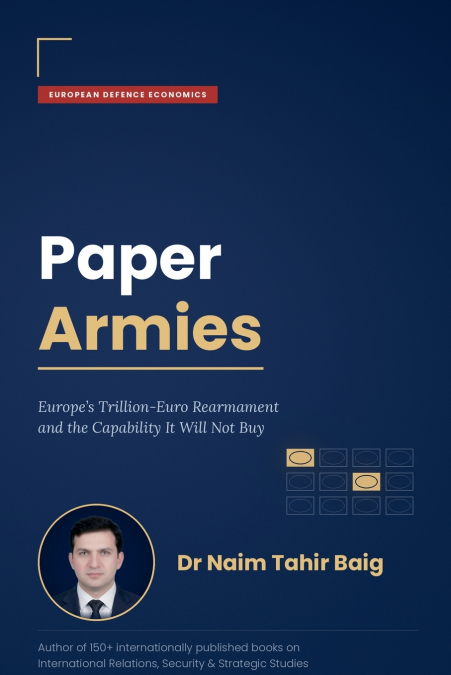
Paper Armies

Paper Armies

Naim Tahir Baig

67,43 €
IVA incluido
Disponible
Editorial:
Institute of Geo-Strategic Studies
Año de edición:
2026
Materia
Guerra y defensa
ISBN:
9798237861334
67,43 €
IVA incluido
Disponible
Añadir a favoritos

In July 2026 the North Atlantic Alliance met in Ankara and recorded, in a declaration six paragraphs long, that European allies and Canada had raised their investment in core defence requirements by more than $139 billion in a single year. Ten months earlier, at Unterlüß in Lower Saxony, Rheinmetall had opened a €500 million artillery plant built in fifteen months, and announced that it would reach full capacity in 2027 - provided the posts were filled, the propellant arrived, and the subcontractors held their schedules. Both statements were true. Neither contradicted the other. They described the same rearmament in two units of account, on two calendars, with two different failure modes. Paper Armies is an attempt to measure the distance between them, and to work out who pays for it.The discipline that makes the measurement possible is a refusal to let four quantities travel under one heading. Money appropriated, money contracted, money spent and capability fielded are four different things, reported by four different institutions, each with its own reason to report it - and nobody, anywhere in Europe, is institutionally responsible for publishing the fourth. Dr Naim Tahir Baig calls the distance between the first and the last the absorption gap, and builds the book around its measurement.The evidence is uncomfortable and almost entirely public. EU-27 defence expenditure reached €418 billion in 2025, a real increase of 20 per cent in a single year. Over the same period, deployable equipment stocks across Europe’s four largest military spenders barely moved: German main battle tanks went from 319 to 313, French howitzers from 120 to 104, British from 215 to 179. Where contracts state a completion date at all, the interval from order to full delivery runs at four to five years - and roughly seventy per cent of German orders now carry no stated completion date. A programme with no published end date cannot be shown to be late.Across twelve chapters the book traces why. It examines the borrowed vocabulary of 'war economy mode' against what the mobilisation literature actually establishes; the labour constraint the state could relieve and has not; the supply-chain chokepoints - energetics, rare earths, castings, mature-node semiconductors - that money cannot open on demand; fragmentation as a stable political equilibrium rather than an inefficiency awaiting reform; what capital markets have already priced; and the collision between defence budgets and an ageing continent’s social commitments.It is written to be capable of losing. Four conditions are stated in Chapter 1 with thresholds attached, before the evidence is assembled. Three can be read now, and all three read against the buildup; the fourth is held open and demoted in the book’s own framing. An appendix converts the argument into twelve public indicators any reader can re-run annually, without assistance and without a subscription.Nothing here is an argument against European rearmament. It is an argument that a shortfall discovered late, all at once, is far harder to repair than one measured and published each year - and that Europe has so far chosen not to publish it.

Artículos relacionados

  • Words of Hope in Troubled Times
    José Ramos-Horta
    The Twenty-first Century offers us a chance, a unique chance, to coalesce around common global interests – to reverse the nefarious consequences of climate change, manage clean water reserves that are becoming a rare commodity, save our polluted rivers, lakes, and seas, replenish the depleted fish stock, eliminate extreme poverty and hunger, and de-escalate tensions on the Kore...
    Disponible

    23,52 €

  • Unmaking the Bomb
    Alexander Glaser / Harold A. Feiveson / Zia Mian
    ...
    Disponible

    33,83 €

  • The Next Space Race
    Peter Garretson / Richard Harrison
    ...
  • Comment l’Occident a amené la guerre en Ukraine
    Abelow
    Selon le récit occidental, Vladimir Poutine est un expansionniste insatiable, semblable à Hitler, qui a envahi l’Ukraine sans provocation. Cette histoire est incorrecte. En réalité, les États-Unis et l’OTAN ont une responsabilité importante dans la genèse de la crise ukrainienne. Par une série de politiques malavisées, Washington et ses alliés européens ont placé la Russie dans...
    Disponible

    8,88 €

  • Insecure Spaces
    Marsha Henry / Paul Higate
    ...
  • Debriefing the President
    John Nixon
    ...
    Disponible

    25,99 €

Otros libros del autor

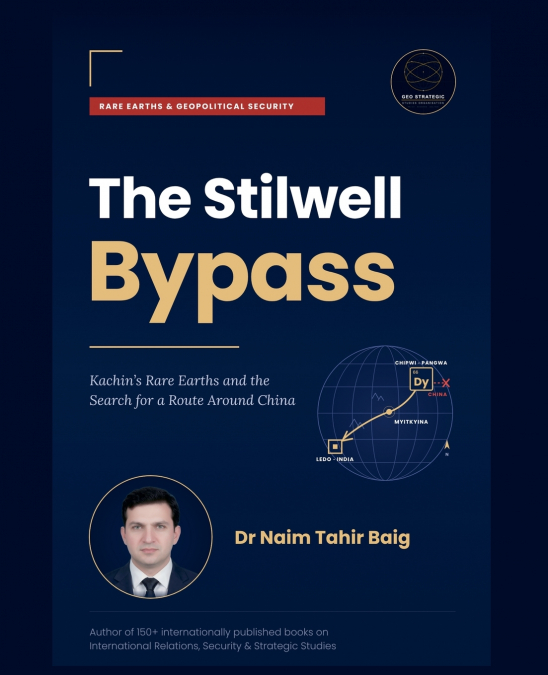
  • The Stilwell Bypass
    Naim Tahir Baig
    In 1942 the United States Army pushed a road out of Ledo, in Assam, toward China. More than eighty years later, a question hangs over the same ground: could a different cargo travel part of that route, heavy rare earths dug from the clay hills of Kachin State in northern Myanmar and carried not east into China, as they are now, but west, toward India and toward separation plant...
    Disponible

    74,68 €

  • Extinction by Extraction?
    Naim Tahir Baig
    What we choose when we choose our mineralsEvery wind turbine, electric vehicle, guided missile and smartphone depends on a group of metals most people have never heard of. Rare earth elements make the modern world’s energy, defense and computing systems possible. They also come from some of the most toxic, concentrated and politically contested supply chains on Earth.Extinction...
    Disponible

    73,62 €

  • Theory in the Interregnum
    Naim Tahir Baig
    Theory in the InterregnumWhich International Relations Theory Explains What in a World of Fraying RulesBy Naim Tahir BaigThe liberal international order is fraying, and every school of International Relations claims to have seen it coming. Theory in the Interregnum asks a sharper question: which theory explains what? Dr Naim Tahir Baig argues that no new grand theory has displa...
    Disponible

    70,52 €

  • Rules of the Strong, Rules of the Many
    Naim Tahir Baig
    Rules of the Strong, Rules of the ManyAuthorship, Membership and the Ratchet of International Norms from Antiquity to the PresentBy Dr Naim Tahir BaigWho writes the rules of international order, and who do those rules protect? Rules of the Strong, Rules of the Many argues that international norms move in two rhythms at once. Authorship, meaning who writes and interprets the rul...
    Disponible

    75,59 €

  • Custody
    Naim Tahir Baig
    CustodyHow States Compete to Govern the Making of PersonsBy Dr Naim Tahir Baig States everywhere are claiming a new kind of authority: the right to act as guardian over how their citizens are formed. A South Korean subsidy to raise the birth rate, an Australian ban on social media for under-16s, a Brazilian court order against a platform and a Chinese rule for generative AI loo...
    Disponible

    75,54 €

  • Dissent as Threat
    Naim Tahir Baig
    Dissent as ThreatNeha Bora, Gender and the Securitisation of Youth Protest in South AsiaBy Dr Naim Tahir BaigWhen a state or a public declares student protest a threat to the nation, the declaration sometimes succeeds and sometimes fails. Dissent as Threat asks when, and why. Its principal case is the 2026 Indian youth movement led by the Cockroach Janta Party with student orga...
    Disponible

    73,75 €