No Religion Is Superior

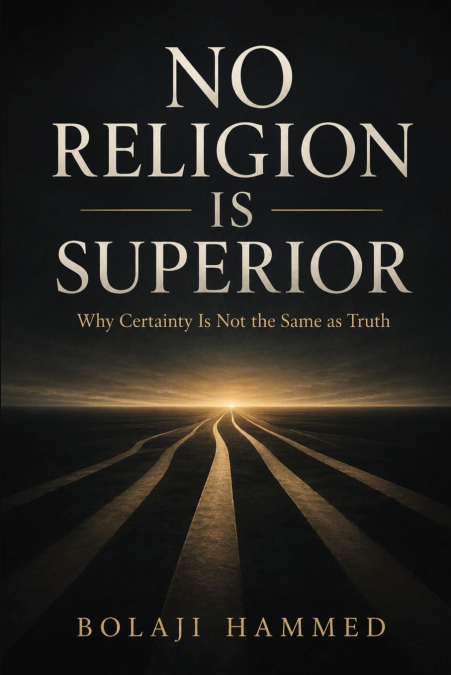
No Religion Is Superior

Bolaji Hammed

14,72 €
IVA incluido
Disponible
Editorial:
Bolaji Hammed
Año de edición:
2026
Materia
Filosofía de la religión
ISBN:
9781067916701
14,72 €
IVA incluido
Disponible
Añadir a favoritos

What if the religion we are most certain about is often the religion we happened to inherit?In No Religion Is Superior: Why Certainty Is Not the Same as Truth, Bolaji Hammed examines one of humanity’s most powerful and sensitive subjects with curiosity, courage, and respect. Rather than attacking faith or asking readers to abandon religion, the book asks a more difficult question: how much of what we believe was independently discovered, and how much was shaped by where we were born, the families who raised us, and the communities that formed us?Drawing from history, philosophy, psychology, ethics, religious traditions, and lived experience, Hammed explores how geography influences belief, how religious certainty is passed from one generation to another, how sacred texts are interpreted, and how religion can become intertwined with politics, power, identity, fear, and social belonging.With particular attention to Africa while addressing questions that are universal, the book also confronts difficult realities surrounding religious superiority, coercion, violence, unanswered prayer, moral responsibility, suffering, and the promises people are sometimes taught to expect from faith.Yet this is not a book against religion.It recognizes the meaning, discipline, hope, community, compassion, and moral direction that faith can provide. Its challenge is directed instead at certainty without examination, belief that requires the inferiority of others, and religious identity that places ideology above humanity.No Religion Is Superior invites Christians, Muslims, followers of traditional religions, people of other faiths, sceptics, and those who are simply questioning to examine not only what they believe, but why they believe it.The goal is not disbelief. It is intellectual honesty.Can we hold conviction without domination? Can we believe deeply without contempt for those who believe differently? Can faith survive honest questions?This book argues that it can, and that a faith tested by humility, compassion, and honest inquiry may ultimately be stronger than certainty that has never been questioned. 6
Artículos relacionados

  • The Writings of Charles De Koninck
    Charles De Koninck
    The Writings of Charles De Koninck, volumes 1 and 2, present the first English editions of collected works of the Catholic Thomist philosopher Charles De Koninck (1906-1965). Ralph McInerny (1929-2010) was the project editor and prepared the excellent translations. Volume 1 contains writings ranging from De Koninck’s 1934 dissertation at the University of Louvain on the philoso...
  • The Constitution of Shambhala (Vol. 7B of a Treatise on Mind)
    Bodo Balsys
    The theme of the first of the two parts of this volume concerns the feminine deva hierarchy, their relation to Hierarchy and Shambhala. Many concepts are introduced that most seekers have little cognisance (e.g., the nature of the deva Lord Varuna). The Mother of the World’s role is revealed, and the feminine function in cosmos, (e.g., the Pleiades). Advanced teaching concernin...
    Disponible

    44,89 €

  • A Labyrinth Walk Of Life
    Lewis Tagliaferre
    Here is a collection of journaled essays leading to the inevitable belief in theological fatalism, aka Theofatalism. They include arguments from theology, psychology, politics, geology, technology, sociology, economics, history, cosmology and more. With this belief system, you can feel good inside no matter what happens outside. It may take several readings to get it, but anyth...
    Disponible

    13,41 €

  • Religion
    Arthur Schopenhauer
    Collected here are five short essays, A Dialogue, A Few Words on Pantheism, On Books and Reading, Physiognomy, and, Psychological Observations, by the world renowned philosopher Arthur Schopenhauer. ...
  • The Handbook
    Epictetus Epictetus
    No writings of Epictetus himself are really known. His discourses were transcribed and compiled by his pupil Arrian (author of the Anabasis Alexandri). The main work is The Discourses, four books of which have been preserved (out of an original eight). Arrian also compiled a popular digest, entitled the Enchiridion, or Handbook. In a preface to the Discourses, addressed to Luci...
  • The Origin Comes Alive
    Cale Rainer
    Believers and Atheists alike will get a firsthand look at the Divine Presence as it reveals the intimate behaviors and processes that compose a sense of GOD, and how this arose in social consciousness to inspire a global phenomenon known as Religion.The sense of life is taken to the limits of extreme perspective in this somewhat involved, yet intimate look into our social origi...
    Disponible

    9,92 €