B.A Frazier
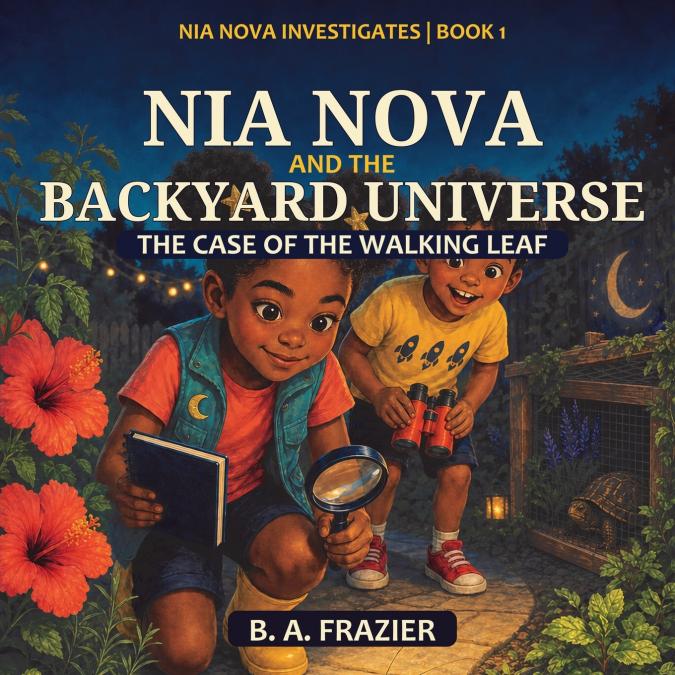
Eight-year-old Nia Nova Castillo sees Abuela Celeste’s backyard as a universe waiting to be mapped. Tomato beds become constellations, herb rows become nebulas, the rain barrel becomes an ocean, and the pale stone path becomes the Quiet Orbit. Nia records each region in her indigo spiral field notebook, not because an adult assigned her a project, but because observation is how she makes sense of the world. She is inventive, patient, and dryly funny, yet she is not written as a child who already knows every answer. Her confidence comes from being willing to look again. That quality is tested when a brown shape crosses the Quiet Orbit while every nearby leaf, streamer, and pinwheel remains perfectly still. Nia first calls it a leaf. Then she notices the contradiction: leaves should not walk when there is no wind.Her six-year-old cousin Mateo joins the case carrying one pair of orange binoculars and enough imagination for an entire investigation team. He proposes that the moving shape might be a tiny ghost wearing a leaf cape. The idea is funny, but the story never treats Mateo as foolish. His unusual theories often expose the exact question a fair test needs to answer. Abuela Celeste gardens nearby, guiding the cousins with calm questions instead of taking control, while Professor Pebble - exactly one small box turtle in a secure, shaded pen - serves as the unofficial laboratory supervisor. Together, these relationships give the mystery its warmth. The backyard feels lived in, safe, and familiar even when the children describe it as unexplored space.Nia opens Case 001 and begins with three explanations broad enough to test: the shape might be moving because of wind, vibration, or an animal. Abuela adds the rule that governs the entire investigation: watch first, and do not touch an unknown living thing. The cousins build a Zero-Wind Detector from exactly three streamers and one pinwheel. Before trusting it, they prove the device works by having Nia breathe gently across it. Only then do they place it near the path. The brown shape moves again, but the detector stays still. Wind becomes less likely. The scene quietly teaches an important habit of scientific thinking: a tool must be checked before its result can support a conclusion.The next test examines vibration. Nia and Mateo mark distances, make controlled taps, and compare the mystery object with an ordinary dry leaf. When the stone vibrates, the mystery shape freezes rather than sliding or rolling. The dry comparison leaf moves across the stone. Nia records both results, including the part she did not predict. A thin dusting of flour on a removable dark board later reveals paired marks, but the pattern is incomplete. Nia refuses to turn partial evidence into a final claim. Then the apparent leaf climbs a twig. In one clear moment, several earlier assumptions fall away: leaves do not have knees, grasp branches, or decide when to move.From a respectful distance, the cousins study the body clues. They see six legs, very long antennae, enlarged hind legs, and folded wings shaped and veined like leaves. The evidence points to a small leaf-mimicking katydid, approximately two inches long, mottled brown-green, and easy to overlook against the right background. Nia calls it the best answer so far.