Moving beyond Theoria toward Theosis

Moving beyond Theoria toward Theosis

Justin A. Davis

50,86 €
IVA incluido
Disponible
Editorial:
Bloomsbury Publishing plc
Año de edición:
2026
Materia
Filosofía occidental: antigua, hasta c. 500
ISBN:
9781666949575
50,86 €
IVA incluido
Disponible
Añadir a favoritos

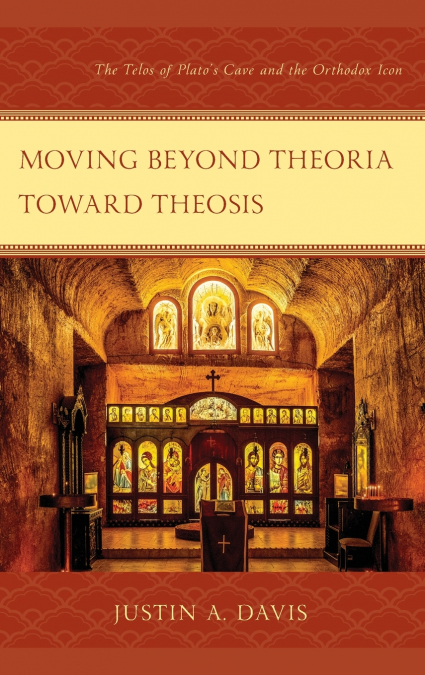
Moving Beyond Theoria Towards Theosis focuses on the telos of man as understood in Plato’s theoria, envisioned in the allegory of the cave, and early Christian reinterpretation of theoria as theosis. In his famed allegory of the cave, Plato maintains that real life exists beyond our base perceptions of reality and is found in the realm of ideas. Theoria is eternal rest in this realm and is understood as the telos of mankind. Plato’s theoria underwent change as it was reinterpreted under middle-Platonic and neo-Platonic thought. These systems incorporated a more mature idea of the divine than Plato, but still minimized the material world. This book explores how early Christianity inherited Plato’s cosmology and terminology. Theoria was also reinterpreted within the Christian context. Eventually the term was abandoned for theosis. Theosis is beyond theoria, as it includes contemplation of the forms as well as union with the source of the forms and the affirmation of the material realm. In this volume, Justin A. Davis shows how the Orthodox use of icons can be key to understanding theosis. The icon is a material object that connects to a higher reality, and ultimately toward union with the divine. Plato’s cosmology is collapsed and transfigured in union with the uncreated energy of God. Icons are the depiction of spiritual ascesis and the new telos of man, theosis. 6
Artículos relacionados

  • The Nature of Things
    Lucretius Lucretius
    De rerum natura (On the Nature of Things) is a 1st century BC didactic poem by the Roman poet and philosopher Lucretius with the goal of explaining Epicurean philosophy to a Roman audience. Lucretius presents the principles of atomism; the nature of the mind and soul; explanations of sensation and thought; the development of the world and its phenomena; and explains a variety o...
  • Pompeii
    Fergus Mason
    Pompeii was one of most advanced cities of its time; it had a complex water system, gymnasium, and an amphitheater. Despite it's advancements, there was one thing it wasn't ready for: Mount Vesuvius—the volcano that led to its ultimate doom.  The 79 AD eruption of Mount Vesuvius was one of the worst disasters in all of European history. In a near instant, over 15,000 p...
    Disponible

    10,36 €

  • Middle Platonism and Neoplatonism, Volume 1
    Stephen Gersh
    'It is generally agreed that those types of philosophy that are loosely called ’Platonic’ and ’Neoplatonic’ played a crucial role in the history of European culture during the centuries between antiquity and the Renaissance. However, until now no scholar has attempted to describe the evolution of these forms of thought in a single comprehensive academic study.' So writes Stephe...
  • Middle Platonism and Neoplatonism, Volume 2
    Stephen Gersh
    It is generally agreed that those types of philosophy that are loosely called 'Platonic' and 'Neoplatonic' played a crucial role in the history of European culture during the centuries between antiquity and the Middle Ages. However, until now no scholar has attempted to describe the evolution of these forms of thought in a single comprehensive academic study. Middle Platonism a...
  • Porphyry’s Commentary on Ptolemy’s Harmonics
    Andrew Barker
    ...
    Disponible

    80,87 €

  • The Roots of Platonism
    John Dillon
    ...
    Disponible

    26,54 €

Otros libros del autor

  • Moving beyond Theoria toward Theosis
    Justin A. Davis
    Moving Beyond Theoria Towards Theosis focuses on the telos of man as understood in Plato’s theoria, envisioned in the allegory of the cave, and early Christian reinterpretation of theoria as theosis. Central to this is the place of icons in the Orthodox Church. ...