Inicio > Economía, finanzas, empresa y gestión > Economía > Macroeconomía > Macroeconomics, Foundations and Frameworks Series
Macroeconomics, Foundations and Frameworks Series

Macroeconomics, Foundations and Frameworks Series

Jay Thatcher

17,23 €
IVA incluido
Disponible
Editorial:
PublishDrive
Año de edición:
2026
Materia
Macroeconomía
ISBN:
9798900421599
17,23 €
IVA incluido
Disponible
Añadir a favoritos

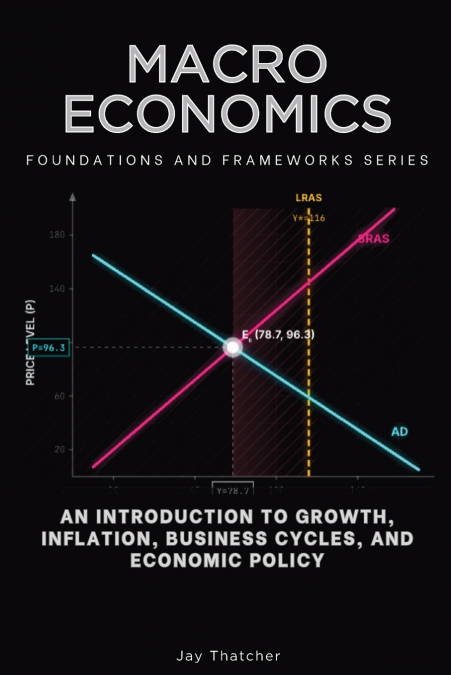
Macroeconomics explained from the ground up, with no prior training assumed. This introduction covers growth, inflation, unemployment, business cycles, and the policy tools governments and central banks actually use. Ten chapters build in a deliberate order, each resting on the one before it. You start with how an entire economy gets measured and finish with exchange rates and the hard limits on what any central bank can do. Technical terms are defined the moment they appear, so you never have to guess your way forward. The ground each chapter covers: - The fallacy of composition, and why a whole economy behaves unlike any household inside it - GDP by expenditure, income, and production, the difference between real and nominal figures, and what national accounts leave out, including unpaid housework and resource depletion - Long-run growth: the rule of 70, the Solow model, diminishing returns to capital, and why institutions decide whether poor countries catch up - Saving, investment, the loanable funds market, and how heavy government borrowing crowds out private spending - How banks create money by lending, why a rumor about one bank can become a self-fulfilling panic, and what deposit insurance changed - Demand-pull and cost-push price rises, menu costs, bracket creep, and how a hyperinflationary spiral starts - Frictional, structural, and cyclical joblessness, the natural rate, NAIRU, and Okun’s law - The anatomy of a cycle: expansion, peak, contraction, trough, aggregate demand and supply, supply shocks, and the Phillips curve tradeoff between prices and jobs - Fiscal and monetary policy side by side: multipliers, automatic stabilizers, debt-to-GDP ratios, the austerity argument, inflation targeting, the zero lower bound, quantitative easing, and the policy trilemma Every chapter ends with discussion questions that ask you to apply what you just read, and worked example answers in the back show what a strong response looks like. A historical timeline puts the major ideas in date order, so you can see how thinking shifted after the Great Depression and the price surges of the 1970s. Economic ideas tend to arrive as reactions to a crisis, so seeing them in sequence makes them easier to hold. A glossary defines every term in one place, and a reading list points you to the sources behind each chapter. Written for: - Students meeting the subject for the first time - Professionals who want to read the financial pages with more confidence - Curious readers tired of nodding along to words they cannot define The examples come from events that actually happened. Germany in 1923, Zimbabwe, the Greek debt crisis, Japan’s long slump, and the choices central banks made under pressure. If you can read a newspaper and handle basic arithmetic, you can follow every page. Once you reach the final page, an economic headline should read as a subject you know rather than a stream of jargon you accept on trust.

Artículos relacionados

  • Introduction to Dynamic Macroeconomic General Equilibrium Models
    José Luis Torres Chacon
    This book offers an introductory step-by-step course in Dynamic Stochastic General Equilibrium modelling. Modern macroeconomic analysis is increasingly concerned with the construction, calibration and/or estimation and simulation of Dynamic General Equilibrium (DGE) models. The book is intended for graduate students as an introductory course to DGE modelling and for those econo...
    Disponible

    61,40 €

  • International Education and the Next-Generation Workforce
    Wei Wang
    Education is the first stage in developing a viable, dynamic, and long-lived global economy. Unfortunately, in times of economic hardship, educational programs, teacher salaries, and extracurricular opportunities are often the first to be cut. International Education and the Next-Generation Workforce: Competition in the Global Economy presents a detailed discussion of present e...
  • Macroeconomic Policies of Developed Democracies
    Robert J Franzese Jr
    ...
  • End Of The Road
    Louis Holder
    This book is about the mismanagement of Western economies in pursuit of political power, which resulting devastation will have to be borne by future generations. The book establishes that postponement is no longer doable and lays out the hard choices ahead causing much misery and agony.Although not fully recognized because of masking by asset bubbles, which are spun/sold as in...
  • The Darwin Economy
    Robert H. Frank
    What Charles Darwin can teach us about building a fairer societyWho was the greater economist-Adam Smith or Charles Darwin? The question seems absurd. Darwin, after all, was a naturalist, not an economist. But Robert Frank, New York Times economics columnist and best-selling author of The Economic Naturalist, predicts that within the next century Darwin will unseat Smith as the...
    Disponible

    19,81 €

  • Myth and Measurement
    Alan B. Krueger / David Card
    From David Card, winner of the Nobel Prize in Economics, and Alan Krueger, a provocative challenge to conventional wisdom about the minimum wageDavid Card and Alan B. Krueger have already made national news with their pathbreaking research on the minimum wage. Here they present a powerful new challenge to the conventional view that higher minimum wages reduce jobs for low-wage ...
    Disponible

    40,01 €

Otros libros del autor

  • Central Banking, Foundations and Frameworks Series
    Jay Thatcher
    Central banking explained in plain English, with no economics degree required. This introduction to monetary policy shows how a decision made in a quiet policy meeting ends up on your mortgage statement, in your savings rate, and behind the prices you pay at the grocery store. The subject has a reputation for being either dull or impossibly technical, and it turns out to be nei...
    Disponible

    17,27 €

  • Microeconomics, Foundations and Frameworks Series
    Jay Thatcher
    Microeconomics explains the prices you pay, the wages you earn, and the way businesses behave when no one is forcing them to be reasonable. This introduction teaches the whole subject in plain language, and it assumes you are starting from zero. The chapters build in order, each one resting on the last. Every idea gets an explanation and a real example before any symbols appear...
    Disponible

    17,24 €