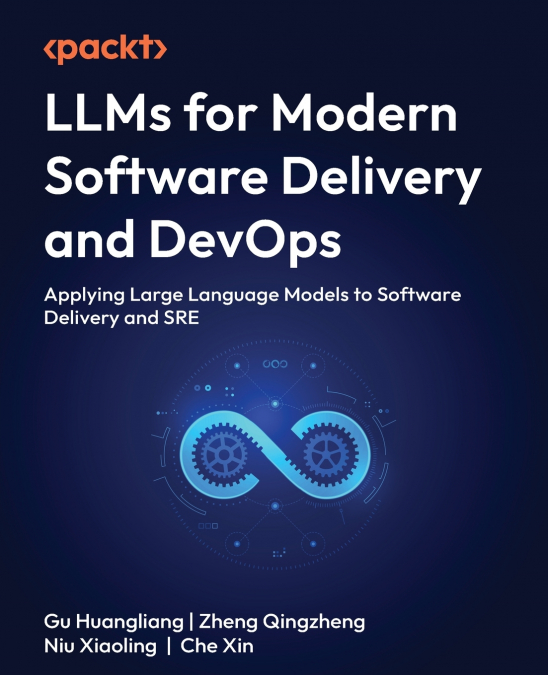
Gu Huangliang / Niu Xiaoling / Zheng Qingzheng
A practical guide to applying LLMs across the software development and delivery lifecycle, improve development, testing, operations, and project efficiency across modern software organizations.Key Features:- Apply LLMs to modern DevOps workflows across development and operations with practical enterprise examples- Build architectural fluency in GPT, fine-tuning, RAG, and agent-based systems- Strengthen software delivery pipelines with AI-informed automation and operational intelligence Book Description:If you work in DevOps, SRE, platform engineering, software delivery, operations, testing, or security, this book shows how large language models (LLMs) can reduce delivery friction, improve operational visibility, and support more reliable engineering workflows. Written by enterprise digital transformation and delivery specialists, it focuses on moving LLMs beyond isolated experiments into practical software delivery systems.You will build the LLM foundations needed to understand modern AI systems, including language model evolution, Transformer architecture, GPT-style generation, and efficient fine-tuning techniques such as LoRA and QLoRA. The book then connects these foundations to enterprise-ready patterns such as retrieval-augmented generation (RAG), multi-agent systems, and platform-based AI assistance. Through operations, testing, coding, project management, and cybersecurity scenarios, you will see how LLMs can support log analysis, ticket handling, root cause analysis, test generation, code generation, risk management, and security workflows.By the end of the book, you will understand how to move from model experimentation to practical AI-assisted delivery, evaluate where LLMs create measurable value across DevOps, SRE, and platform engineering workflows, and recognize the constraints, risks, and governance considerations involved.What You Will Learn:- Apply RAG and multi-agent patterns to enterprise software delivery and platform engineering scenarios- Use LLMs to support operations tasks such as log analysis, ticket handling, incident response, and root cause analysis- Explore how LLMs can improve software testing, static analysis, vulnerability repair, and test automation workflows- Apply code LLMs to development workflows, including code generation, completion, review support, and project-level coding tasks- Use LLMs to support project management, delivery coordination, risk analysis, and cybersecurity workflows- Evaluate the practical value, risks, and constraints of introducing LLMs into DevOps, SRE, and platform engineering environmentsWho this book is for:This book is for software engineers, DevOps and SRE professionals, QA and security teams, and technical managers who want to apply and operationalize LLMs across the software delivery lifecycle.Table of Contents- Introduction to Large Language Models- The Cornerstone of Large Language Models-Transformer- From Transformer to ChatGPT33- Fine-Tuning Techniques for Large Language Models- Enterprise AI Application Technology- RAG- Three Foundational Pillars of Software Delivery- Practical Applications of Large Language Models in Operations Scenarios- Practical Applications of Large Language Models in Testing Scenarios- Practical Applications of Large Language Models in Programming Scenarios- Practical Applications of Large Language Models in Project Management Scenarios- Practical Applications of Large Language Models in Security Scenarios