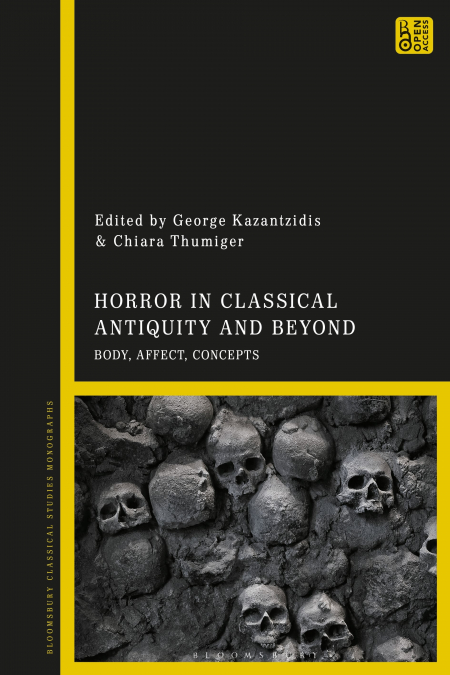
Horror in Classical Antiquity and Beyond

Horror in Classical Antiquity and Beyond


53,30 €
IVA incluido
Disponible
Editorial:
Bloomsbury Publishing plc
Año de edición:
2026
Materia
Filosofía occidental: antigua, hasta c. 500
ISBN:
9781350380653
53,30 €
IVA incluido
Disponible
Añadir a favoritos

This open-access volume is the first to explore systematically and comprehensively the concept and category of ’horror’ in antiquity. The contributors retrieve the ancient grammar of horror by paying equal attention to its affective and cognitive dimensions, and by looking at it as an embodied, enactive and full-rounded existential experience. They explore how horrifying experiences in antiquity are construed as embodied events while being conceptually rooted in cultural frameworks. They also showcase the ways in which the body itself can turn into a source of deep horror, be it in literary or medical texts and traditions in the Greek and Roman world, from the classical period to late antiquity. While maintaining a firm awareness of the fact that ’horror’, a largely post-Romantic concept, is not unproblematic when applied to Graeco-Roman antiquity, this collection of studies shows that our Graeco-Roman past can shed substantial light on the ways in which the horrific is understood today, as a category of art but also of life itself.The eBook editions of this book are available open access under a CC BY-NC-ND 4.0 licence on bloomsburycollections.com. Open access was funded by the Exzellenzcluster ROOTS, Christian-Albrechts-Universität zu Kiel (Germany). 6

Artículos relacionados

  • The Nature of Things
    Lucretius Lucretius
    De rerum natura (On the Nature of Things) is a 1st century BC didactic poem by the Roman poet and philosopher Lucretius with the goal of explaining Epicurean philosophy to a Roman audience. Lucretius presents the principles of atomism; the nature of the mind and soul; explanations of sensation and thought; the development of the world and its phenomena; and explains a variety o...
  • Pompeii
    Fergus Mason
    Pompeii was one of most advanced cities of its time; it had a complex water system, gymnasium, and an amphitheater. Despite it's advancements, there was one thing it wasn't ready for: Mount Vesuvius—the volcano that led to its ultimate doom.  The 79 AD eruption of Mount Vesuvius was one of the worst disasters in all of European history. In a near instant, over 15,000 p...
    Disponible

    10,36 €

  • Middle Platonism and Neoplatonism, Volume 1
    Stephen Gersh
    'It is generally agreed that those types of philosophy that are loosely called ’Platonic’ and ’Neoplatonic’ played a crucial role in the history of European culture during the centuries between antiquity and the Renaissance. However, until now no scholar has attempted to describe the evolution of these forms of thought in a single comprehensive academic study.' So writes Stephe...
  • Middle Platonism and Neoplatonism, Volume 2
    Stephen Gersh
    It is generally agreed that those types of philosophy that are loosely called 'Platonic' and 'Neoplatonic' played a crucial role in the history of European culture during the centuries between antiquity and the Middle Ages. However, until now no scholar has attempted to describe the evolution of these forms of thought in a single comprehensive academic study. Middle Platonism a...
  • Porphyry’s Commentary on Ptolemy’s Harmonics
    Andrew Barker
    ...
    Disponible

    80,87 €

  • The Roots of Platonism
    John Dillon
    ...
    Disponible

    26,54 €