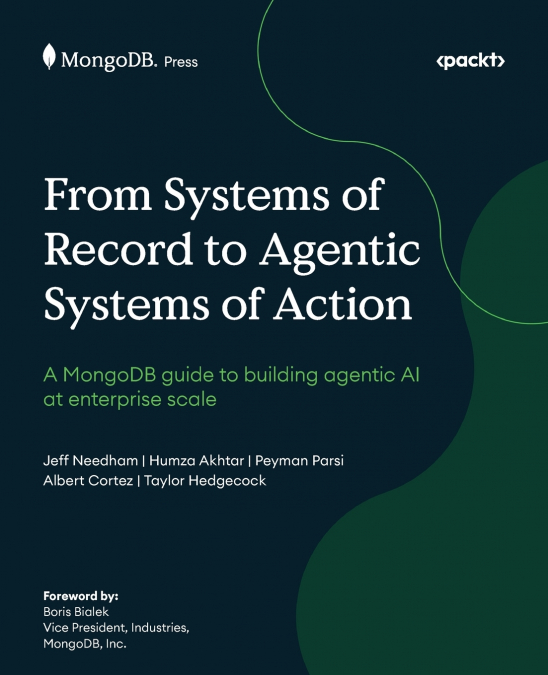
Humza Akhtar / Jeff Needham / Peyman Parsi
Learn how Systems of Action move agentic AI beyond the pilot stage through business context, decision traces, governed action, and coexistence with systems of recordKey Features:- Design an Intelligence Context Layer around enterprise business objects- Keep systems of record authoritative while humans and agents act- Apply transferable Systems of Action patterns across industries- Purchase of the print or Kindle book includes a free PDF eBookBook Description:Enterprise AI pilots often stall when agents meet fragmented data, systems designed around human workflows, and production requirements for control and auditability. From Systems of Record to Agentic Systems of Action shows how to build Systems of Action that work with the systems of record an enterprise already depends on, without making wholesale replacement a prerequisite.You’ll learn to design an Intelligence Context Layer that keeps business context, enrichments, retrieval structures, and decision traces connected to business objects. The architecture is worked through on MongoDB, showing where agent memory and working state fit, how source systems remain authoritative, and how humans and agents reason and act through governed paths.Written by MongoDB practitioners and industry specialists, the book covers event-driven synchronization, information modeling, semantic retrieval, controlled writeback, multi-agent coordination, human oversight, identity, and auditability. Worked examples span insurance, healthcare, manufacturing, and financial services, each exposing a different operating condition so readers can transfer the architecture to their own industry. MongoDB Vector Search, Time Series, Atlas Stream Processing, MCP, and agentic RAG appear where they solve a concrete design need.What You Will Learn:- Keep systems of record authoritative while agents act- Design an Intelligence Context Layer around business objects- Capture decision traces and decision-relevant context- Use retrieval, memory, and state in agent workflows- Synchronize context with event-driven data flows- Coordinate multi-agent workflows with human checkpoints- Design governed writeback, identity, and audit controls- Scale agent systems into shared enterprise infrastructureWho this book is for:This book is for enterprise and solution architects, AI architects and engineers, product owners, engineering managers, platform and data engineers, senior developers, data and platform engineers, engineering leaders, and technology leaders responsible for bringing agentic AI into production. Its architecture applies across industries; worked examples come from insurance, healthcare, manufacturing, and financial services. Familiarity with enterprise architecture, data platforms, and core AI concepts is helpful; no prior MongoDB experience is required.Table of Contents- From Systems of Record to Systems of Action- The Intelligence Context Layer- The Coexistence Reality - AI Alongside Legacy Systems- From Experiment to Product - A Mindset & Architecture for Lasting AI- Information Architecture for Systems of Action- Design and Integration Patterns for Action- Bridging Patterns to Practice: How to Read the Use Cases- Agent-Enhanced Claim Handling: The Canonical System of Action- The Underwriting Intelligence Layer: Parallel Agents and Bounded Authority- The Member Care Coordination Layer: From Prior Authorization to Continuous Care- A Unified Namespace Architecture for Manufacturing Systems of Action(N.B. Please use the Read Sample option to see further chapters)