Rita Santillan
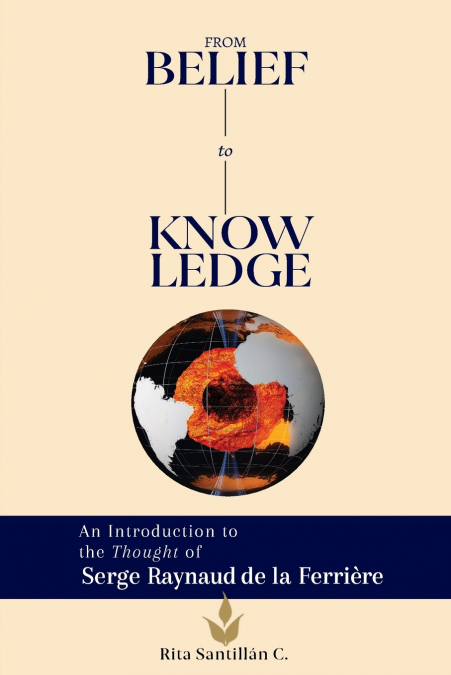
From Belief to Knowledge covers the ideological, doctrinal, and methodological aspects of Raynaud de la Ferrière’s thinking and is divided into nine chapters.Chapter 1 is an introduction concerning human beginnings and evolution. He affords great importance to the equinoctial precession and its sociological and geochronological projections. He verified that these great cycles are marked by profound sociological, psychological and religious changes. He argues that our civilization is in the process of adopting thoroughly new social and religious forms. Metaphorically, it is being wrapped in a dress of unknown cut and colour.In Chapter 2, the equatorial electrojet (EEJ) provides a massive and tacit endorsement of his conclusions. In discussing precessional ages, R. de la Ferrière mainly used the equation of equinoxes, which according to his math calculations, the vernal point intersects at 0o into the Constellation of Aquarius on March 21, 1948. This inexorable celestial motion then manifests itself in symbolic facts and concrete results.A few examples of his avant-garde research from more than 70 years ago are discussed in Chapter 3. He approached both science and philosophy, but always sought to balance objectivity and subjectivity.Chapter 4 focuses on transition. The salient characteristics of the Age of Knowledge (Aquarius) and the preceding Age of Belief (Pisces) are depicted in comparative tables and significant phases are identified. These encapsulate the distinctive features of each Age and also help us to identify the key characteristics of the transitional period. The values of both Ages can overlap and new ideologies can emerge.One of the most revolutionary aspect of R. de la Ferrière thought is portrayed in Chapter 5. He posits an ’epistemology of life’ as necessary to analyze the different manifestations of what he called the Supreme Cause, or God. 'Life' he says, 'in its deepest sense is a dominion of precious investigations that should be appreciated for their true value: Those things we call sacred are exactly those that contain the most life.' He projects a new concept of Divinity, in which the Supreme Cause contains the Non-Manifested and the Manifestation.Each Age gives rise to a New Teaching, a new way of thinking. Several established cannons collapse and give way to new ones. Chapter 6 includes some comparative analysis of the fundamental teachings associated with specific precessional Ages. Retrospectively, his comments on the Emerald Tablet of the Age of Gemini are discussed, in which he equates the mystery of it with that of the Great Sphinx in Egypt. His proposal for a new hermeneutics expands current perspectives. The historical sense of eternity, immutability and transformation evident before a new precessional is tackled. Chapter 7 depicts ’Yoghism’ that he develops based on ancient traditional yoga. It is not a new philosophical school or brand of yoga, but rather a synthesis of all types of yoga. He posits a relationship between Yoghism and jñāna-yoga. Jñāna, which means Knowledge in Sanskrit, features bhumis (consciousness states), dathus (elements) and nagasidhis (faculties). The Upanishads (ancient Vedic sacred texts) proclaimed the superiority of jñāna Yoga. Serge Raynaud de la Ferrière’s life itself manifested a synthesis, and his biography is dialectically discussed in Chapter 8. Chapter 9 portrays what happened with his foundations after his death. His last direct disciple, David Ferriz brought his considerable intellectual and spiritual talents to re-establish the Universal Great Brotherhood UGB as envisioned by R. de la Ferrière, but his efforts were dogmatically contested. In October of 1990, Ferriz lead the ’Exodus of Knowledge’ from the UGB to safeguard R. de la Ferrière’s thought.