Jossef Salman
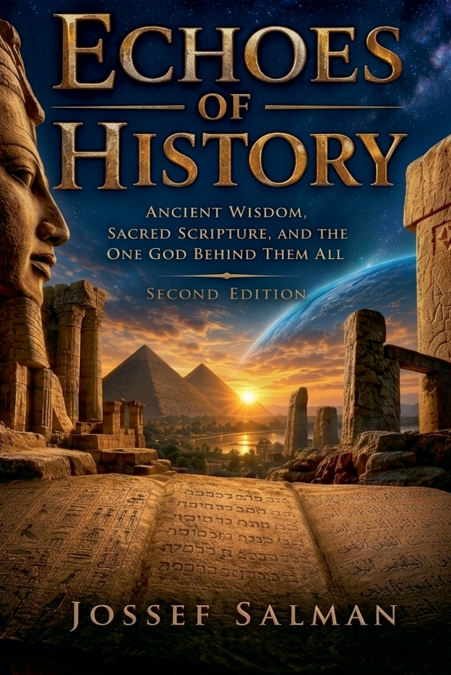
Eleven thousand years ago, people who had not yet learned to farm raised carved stone pillars on a hill in Turkey - and then deliberately buried them.They had no pottery, no metal, no writing, no cities. They spent enormous effort on something that did not feed them. Whatever Göbekli Tepe was for, the reason lay outside survival.That is where this book begins. It is not where it ends. What follows runs through archaeology, scripture and lost civilizations.ECHOES OF HISTORY is an investigation into the things in the ancient record that do not fit - and into what they suggest about where the idea of God actually came from.Why the geology of the Sphinx enclosure points to water damage from an age before Khafre - and why the only inscription naming a pharaoh was carved a thousand years later, and is damaged.Why sixty-ton granite boxes in the Serapeum at Saqqara are machined flat on the inside, where no one would ever see, and sit in niches too narrow to move them into.Why Egypt’s finest stone vessels are among its earliest - and the quality declines afterward, which is the wrong shape for a learning curve.Why the Sumerian King List and the Book of Genesis, which owe each other nothing, both split history at a flood and both name the same city as the seat of kingship afterward.Why the Qur’an and Genesis both describe the flood as water from below and water from above at once - a strange way to describe rain, and an exact way to describe the end of an ice age.What a corridor nine meters long, sealed inside the Great Pyramid and found in 2023 by counting cosmic particles, means for everything we were taught about who built it.From there the argument widens: through Mesopotamia, Noah and the flood; through Enoch, Thoth, Hermes and Nabu; through Abraham, Joseph and a re-dated Exodus; through the Pyramid Texts, the Dead Sea Scrolls, the Council of Nicaea, the Kabbalah and the Emerald Tablet; and through what the Torah, the Gospels and the Qur’an actually say when they are read side by side.The claim underneath all of it is a single one. Humanity did not invent the idea of a Creator. It received it - and then divided it, translated it, attached names to it, and half forgot it. Every pantheon on earth kept one god above the crowd. The gods of the ancient world are not the ancestors of monotheism; they are its wreckage.What makes this book different from everything shelved beside itIt refuses both ends. Ancient astronaut theory took a real puzzle and answered it with science fiction; this book says so, by name. Fundamentalism took the same puzzle and told you not to ask; this book says that too. What is left is a writer who labels every claim as measurement, model, or belief - and tells you which is which, every time.It also argues with itself. This second edition publicly withdraws more than a dozen claims from the first, on the page, with reasons: a catastrophe he no longer needs to invent, a linguistic argument he now knows was built from the wrong evidence, an accusation against a scholar he retracts and apologizes for. Faith should not need me to be afraid of evidence.Jossef Salman is a Muslim and says so on the first page. He is also harder on his own tradition than on anyone else’s, holds several positions his own community does not, and asks you not to believe any of it because he wrote it.Fully revised and expanded second edition. For readers of Graham Hancock, Robert Schoch and John Anthony West who want the same territory handled by someone who cites the counter-evidence - and for anyone who has felt squeezed between a scientific account they cannot fully evaluate and a religious one they have been told not to read.