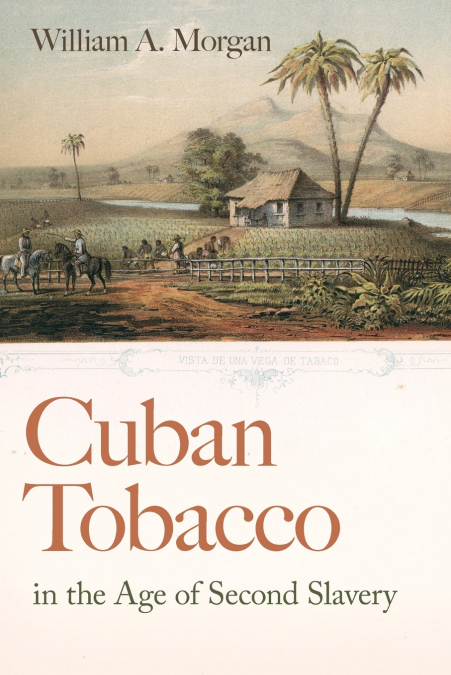
Cuban Tobacco in the Age of Second Slavery

Cuban Tobacco in the Age of Second Slavery

William A Morgan

36,80 €
IVA incluido
Disponible
Editorial:
Longleaf on behalf of Univ of Georgia Press
Año de edición:
2026
Materia
Historia de América
ISBN:
9780820376899
36,80 €
IVA incluido
Disponible
Añadir a favoritos

By 1865, more than 750,000 enslaved Africans had arrived in Cuba, making it the leading Spanish American slave colony and the epicenter of slavery in the Atlantic. At the height of the global tobacco economy, tens of thousands of these slaves labored in Pinar del Río, Cuba--a region devoted exclusively to tobacco cultivation. These enslaved people were responsible for exporting a record fourteen million pounds of raw tobacco per year, leaving one contemporary writer to argue that no agricultural economy produced more value, in proportion to the capital and labor employed, than tobacco. While tobacco was second only to sugar in export significance and in the number of rural enslaved, tobacco was unequivocally as dependent on enslaved labor as the more infamous export. Despite Cuba being one of the first-introduced and last-abolished slave societies in the Atlantic world, this slave economy remains largely ignored, existing outside the considerable and recent scholarship on the region.Cuban Tobacco in the Age of Second Slavery directly refutes the myth of tobacco as a small-scale, family, and free-labor crop promoted by both contemporary and current scholarship. It also rejects the prevailing use of sugar as the model for epitomizing Cuban slavery--a paradigm that obscures the full measure of diversity in this region and era. Arguing tobacco was more counterpart than counterpoint to sugar, Cuban Tobacco in the Age of Second Slavery focuses on the development of tobacco as a plantation economy--and the exponential increase in forced labor supporting it--to suggest an alternative narrative in understanding both Cuban and Atlantic slavery in this period.

Artículos relacionados

  • Pan-Africanism and Education
    Kenneth J. King / Kenneth JKing
    This is an analysis of the complex links between Black America and Africa in the period of 1880 to 1945. It examines an extended white attempt to pattern politics and education in colonial Africa upon the example of the U.S. South. This export of United States race relations to Africa was resisted by Black intellectuals in the United States and many of the early nationalists in...
    Disponible

    24,60 €

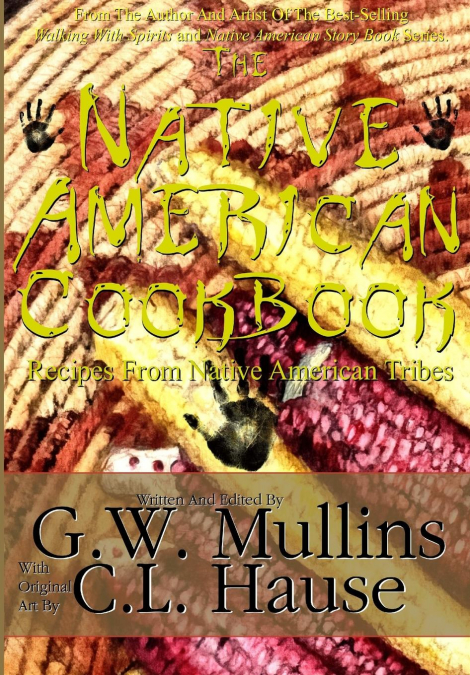
  • The Native American Cookbook Recipes From Native American Tribes
    G.W. Mullins
    Light Of The Moon Publishing along with Author G.W. Mullins and Illustrator / Artist C.L. Hause have joined together to explore Native American Indian Cooking.  More than just a cookbook, this Native American recipe collection offers a look into a forgotten past.  'The Native American Cookbook Recipes From Native American Tribes,' offers a large collection of recipes from and i...
    Disponible

    24,56 €

  • A Public Spirit
    George H. Atkinson
    George Henry Atkinson (1819-89) was a son of New England who arrived in the Oregon Territory in 1848, sent by the American Home Missionary Society. Although his commission from the Society specified that his work was to be ecclesiastical and educational, he took an approach to that assignment which went well beyond his mandate. Well-informed and energetic, he made an impact on ...
    Disponible

    10,45 €

  • North Carolina Women of the Confederacy
    Lucy London Anderson
    Long out of print, this volume of recollections, stories, and verse provides a glimpse of women's lives on the home front-and sometimes in the thick of battle-during the War between the States. Nearly fifty years after the American Civil War, Lucy Worth London Anderson (Mrs. John Huske Anderson) of Fayetteville, N.C., compiled one of the first memorial collections honoring the...
    Disponible

    17,20 €

  • Freedom by a Thread
    Freedom by a Thread: The History of Quilombos in Brazil brings together some of the best scholars in the world working on the history of quilombos (maroon societies) in Brazil from a variety of perspectives and approaches. Over 40 percent of the total volume of captive Africans arrived in Brazil during a 400-year period of legal and contraband transatlantic slaving. If slavery ...
    Disponible

    36,71 €

  • Nashville Baseball History
    Bill Traughber
    Nashville is a Big League city despite never having been home to a major league team. From the Civil War era, to star-studded exhibitions, to outstanding Negro Leagues teams, to some of the great minor league franchises of all time, few cities have as rich a baseball tradition as Nashville, Tennessee.Nashville sports historian Bill Traughber, who has been writing about baseball...
    Disponible

    13,15 €