Reza Nazari
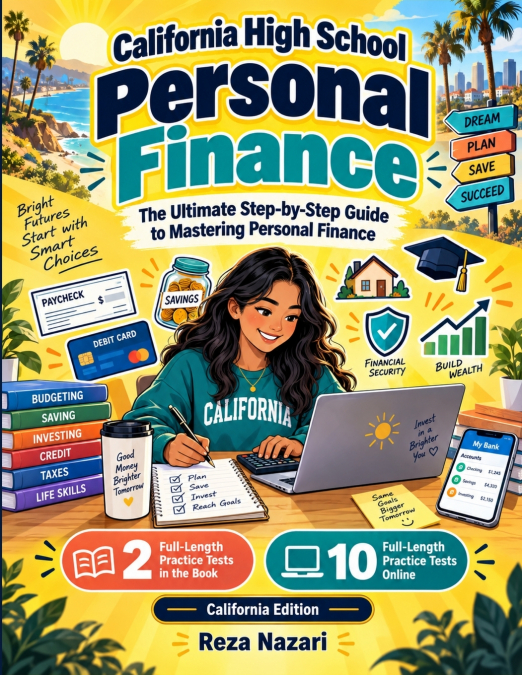
Money decisions show up early. A first paycheck brings taxes and take-home pay. A car comes with financing, insurance, fuel, and repair costs. Education plans raise questions about tuition, aid, loans, and future earnings. California High School Personal Finance gives students a practical way to work through those choices before the stakes grow.The book teaches through plain-language lessons, realistic documents, worked calculations, and focused practice. Students learn why a choice works instead of memorizing a loose collection of rules. They read pay stubs, compare job offers, build budgets, investigate bank fees, calculate interest, evaluate credit, and decide when insurance is worth its cost. The numbers are shown in full, with the step that changes the decision made clear.Twenty chapters follow a steady path from everyday choices to larger commitments. The opening chapters cover scarcity, incentives, opportunity cost, needs, wants, and trade-offs. Students then study earnings, education costs, payroll deductions, taxes, budgeting, consumer decisions, car buying, banking, saving, investing, retirement, credit, debt, insurance, housing, and the first year of independent living.This California edition includes a focused overview of the state’s approach to financial education and directs readers to official California resources. The state material gives useful context without interrupting the full personal finance course. The book is independently published and does not claim sponsorship or endorsement by a government agency, school district, financial institution, or regulatory body.Inside the book:• 20 focused chapters in a clear teaching sequence• Worked examples using dollars, percentages, rates, and time• 15 to 20 practice questions in every chapter• Short answers and complete explanations for checking the reasoning• Two 50-question full-length practice tests in the book• Ten additional online practice tests for continued review• A formula reference, rate tables, glossary, study guidance, and online learning toolsComplete explanations do more than identify a choice letter. They show the deciding calculation or rule, connect it to the situation, and point out a likely wrong turn when that helps. Students can mark an uncertain answer, check the explanation, and return to the exact skill that needs another attempt.Teachers can use the chapters for a semester course, a financial literacy unit, intervention, independent study, or review. Families and tutors can work through one topic at a time. A student studying alone can read a lesson, try the practice without notes, check the explanation, and repeat any missed skill. The companion online center adds flashcards, quick review material, lessons, quizzes, calculators, and ten additional tests.The examples identify the figures they use and place the arithmetic in front of the reader. When a tax threshold, contribution limit, or other annual figure changes, the method still transfers. That matters. Financial literacy depends on knowing what to compare, what to calculate, and which question to ask before signing, borrowing, buying, or investing.California High School Personal Finance is written for high school students and beginning learners who want useful financial knowledge without dense jargon. It can support classroom instruction, homeschooling, tutoring, career-readiness programs, adult education, or self-study. No previous finance course is required.