Raj Clark / Roggie Clark
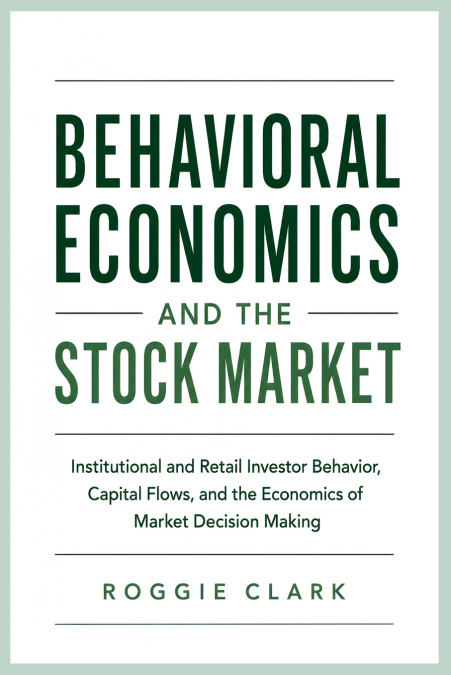
The stock market is often described through prices, charts, valuations, earnings, and economic data. But behind every trade, investment allocation, fund redemption, and portfolio decision are people responding to incentives, expectations, risk, uncertainty, and the behavior of other market participants.Behavioral Economics and the Stock Market explores how behavioral economics can help us understand the decisions of both institutional and retail investors, and what happens when those decisions interact across financial markets.Rather than treating professional investors as perfectly rational and retail investors as purely emotional, this book examines human decision making throughout the investment system. Hedge funds, mutual funds, asset managers, pension funds, other institutional investors, and individual investors may operate at very different scales, but their decisions are still influenced by information, incentives, expectations, risk perception, and human behavior.Readers will explore concepts such as loss aversion, herd behavior, overconfidence, anchoring, framing, confirmation bias, social proof, and recency effects, while examining how these behavioral tendencies can influence investment decisions and market activity.The book also looks beyond individual decisions to explore a larger economic question: what happens when the behavior of different market participants begins to interact?Retail investors can move money into and out of investment products. Asset owners can change allocations. Fund flows can affect the capital available to investment managers. Institutional investors can respond by changing portfolios, managing liquidity, or buying and selling securities. Those actions can influence market prices and sentiment, which can then affect the next decisions made by investors.Through this perspective, readers will examine the relationship between investor psychology, institutional behavior, capital flows, market activity, bubbles, market downturns, and financial decision making.This is not a stock-picking manual or a guide promising to predict the market. It is an exploration of the economics and human behavior behind financial markets, designed for readers who want to better understand how individual decisions can interact, spread, and sometimes contribute to much larger movements of capital.