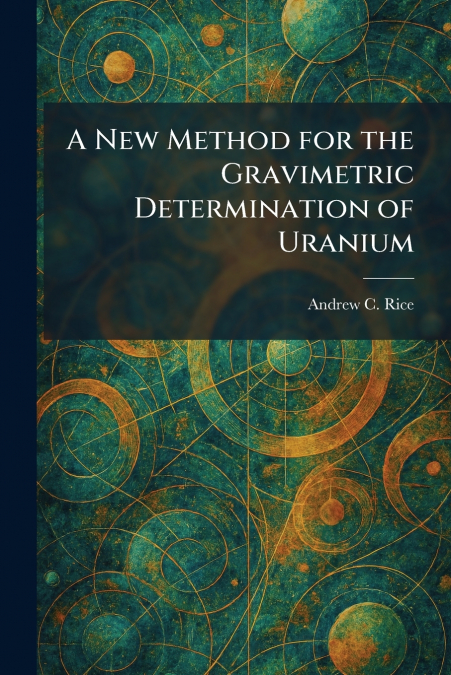
Andrew C. Rice
'A New Method for the Gravimetric Determination of Uranium' is a specialized scientific treatise by Andrew C. Rice that presents a refined analytical technique for measuring uranium content through gravimetric analysis. This work details a specific laboratory procedure designed to improve accuracy and efficiency in the chemical evaluation of uranium-bearing materials. The text explores the precipitation and weighing processes essential to quantitative chemical analysis, providing a rigorous framework for researchers and chemists working in the fields of mineralogy and metallurgy. Rice focuses on the chemical reactions and the specific reagents required to isolate uranium, offering a step-by-step methodology that reflects the advancements in analytical chemistry during the early 20th century. This monograph serves as a significant historical document for those interested in the evolution of chemical testing and the development of standardized protocols for elemental determination. It remains a valuable resource for understanding the foundational methods used in the chemical assessment of heavy elements and the technical rigor required in laboratory research of the era.This work has been selected by scholars as being culturally important, and is part of the knowledge base of civilization as we know it. This work was reproduced from the original artifact, and remains as true to the original work as possible. Therefore, you may see the original copyright references, library stamps (as most of these works have been housed in our most important libraries around the world), and other notations in the work.This work is in the public domain in the United States of America, and possibly other nations. Within the United States, you may freely copy and distribute this work, as no entity (individual or corporate) has a copyright on the body of the work.As a reproduction of a historical artifact, this work may contain missing or blurred pages, poor pictures, errant marks, etc. Scholars believe, and we concur, that this work is important enough to be preserved, reproduced, and made generally available to the public. We appreciate your support of the preservation process, and thank you for being an important part of keeping this knowledge alive and relevant.